
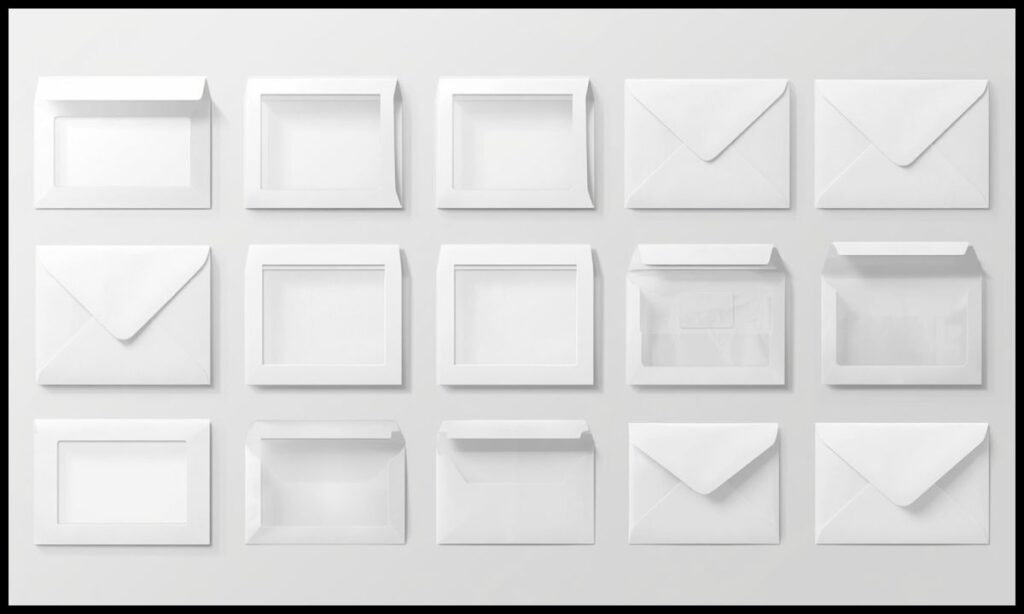
An envelope can look like a very simple piece of paper, but the moment a clear window appears on it, measurements start mattering a whole lot.
A few millimeters in the wrong direction can hide part of a name, push an address too close to the edge, or make a perfectly printed letter look oddly misplaced. That is why understanding window envelope sizes is useful for businesses, printers, offices, and anyone preparing professional mail.
Window envelopes are designed so that an address printed on a letter or document can appear through a transparent opening. Instead of writing the address again or attaching a label, the document itself does the addressing job. It sounds small, almost boring really, but this little feature saves time when hundreds of letters are being prepared.
The tricky part is that there isn’t one universal standard window envelope size. Different countries, envelope formats, postal systems, and manufacturers can use different measurements. US commercial envelopes, UK DL envelopes, and ISO C-series envelopes may all place their windows differently, so checking the actual specification before printing is a smart move.
This guide explains window envelope dimensions, common envelope formats, window measurements, window placement, and practical printing considerations in one place.
What Are Window Envelopes?
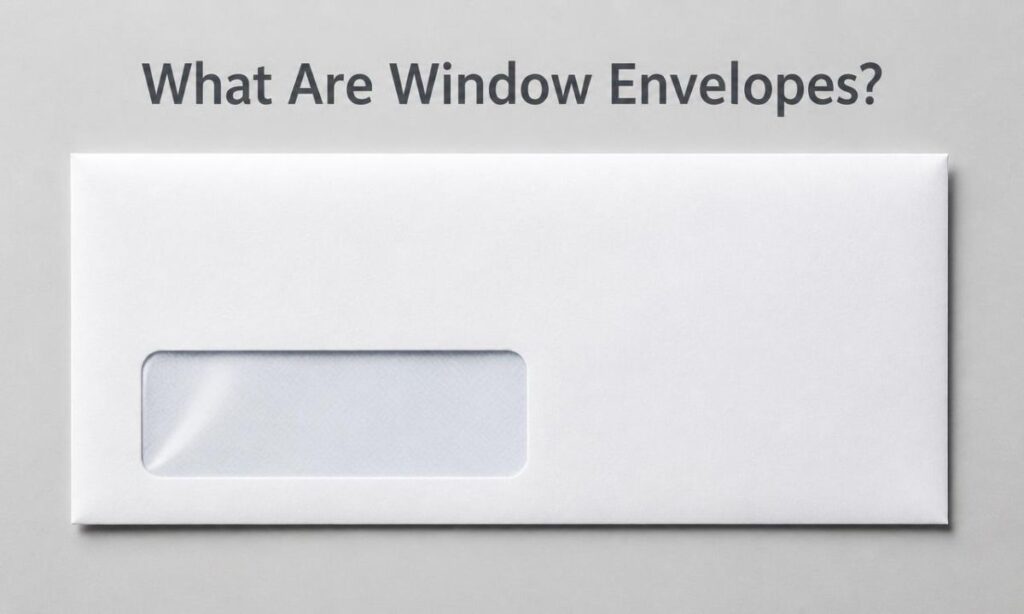
A window envelope is an envelope with a transparent section, usually made from thin plastic or another translucent material, through which the recipient’s address can be seen. The address window is normally positioned on the front panel where postal services and automated sorting equipment can read it easily.
The main purpose is convenience. A company sending invoices, statements, checks, bills, or general business correspondence can print the recipient’s information directly onto the enclosed document. Once folded correctly, the address lines line up with the envelope window. Simple idea, very useful result.
Window envelopes can have one opening or two. A single-window envelope usually displays the recipient’s address, while a double-window envelope may provide another opening for information such as a return address or sender details.
The window itself is only one part of the specification. The overall envelope dimensions, flap style, opening direction, paper size, fold pattern, and envelope window position all work together.
Why Window Envelope Sizes Matter
Choosing the correct window envelope size isn’t simply about finding an envelope that can physically hold your paper. The document must fit comfortably inside, and the printed address must land in the correct area when the paper is folded.
Imagine printing 500 invoices and discovering afterward that the postal code sits partly underneath the edge of the window. That’s the kind of tiny problem that becomes a very expensive tiny problem.
Correct envelope window measurements help avoid these issues. They also make mail look cleaner and more professional, particularly when envelopes are being used for business correspondence.
For automated mailing, positioning can matter even more because postal systems may rely on optical character recognition, barcodes, and machine-readable address zones. A properly positioned address is easier for people and machines to identify.
Window Envelope Sizes and Standard Dimensions
There are several families of envelope sizes, and their naming systems differ. In the United States, commercial envelopes are commonly identified with numbers such as #10, while many international formats use the ISO metric system.
The ISO system includes C-series and B-series envelopes. The C series is particularly important because its dimensions are designed around standard paper sizes. This makes it easier to select an envelope for unfolded or folded documents.
Here are some common ISO envelope sizes:
| Envelope | Approximate dimensions |
|---|---|
| C3 | 324 × 458 mm |
| B4 | 250 × 353 mm |
| C4 | 229 × 324 mm |
| B5 | 176 × 250 mm |
| C5 | 162 × 229 mm |
| B6 | 125 × 176 mm |
| C6 | 114 × 162 mm |
| DL | 110 × 220 mm |
| C6/C5 | 114 × 229 mm |
| C7/6 | 81 × 162 mm |
| C7 | 81 × 114 mm |
These measurements describe the envelope itself, not necessarily the transparent window. The envelope window size and its position need to be checked separately.
US Window Envelope Sizes
US mailing envelopes use several familiar formats, especially commercial envelopes. The #10 envelope is perhaps the one most people recognize from everyday office mail, though many other sizes are available.
Common commercial formats include #6 ¼, #6 ¾, #7 ¾, #8 ⅝, #9, #10, #11, #12, and #14. Some specialized formats, such as Monarch envelopes, are also used for particular types of correspondence.
For a standard window envelope size, one commonly referenced US single-window measurement is approximately 1 ⅛ × 4 ½ inches. The window may be positioned around ⅞ inch from the left edge, with the lower placement depending on the particular envelope specification.
That last part is important because window placement can vary between manufacturers. A window that looks correct on one #10 envelope isn’t automatically correct for every #10 envelope on the market. Always check the manufacturer’s template when accuracy matters.
USPS Recommended Window Size and Placement
Postal requirements are one reason that USPS recommended window size and placement are often discussed when preparing business mail. The address needs to remain visible and located within the appropriate addressing area.
A commonly referenced single-window arrangement uses a window around 1 ⅛ × 4 ½ inches. Depending on the specific envelope and postal application, the window may sit roughly ⅞ inch from the left edge and around ½ to ⅝ inch from the bottom.
These figures should be treated as specification examples rather than a universal rule for every envelope. Postal standards, envelope construction, and mail-processing requirements can differ, so high-volume mailing should be checked against the current requirements applicable to the mailing service being used.
It is also wise to keep the recipient’s address comfortably inside the visible window. If a line touches the plastic edge, even a tiny folding difference can make part of the address disappear, which is not exactly the grand finale anyone wants for 2,000 envelopes.
DL Window Envelope Sizes
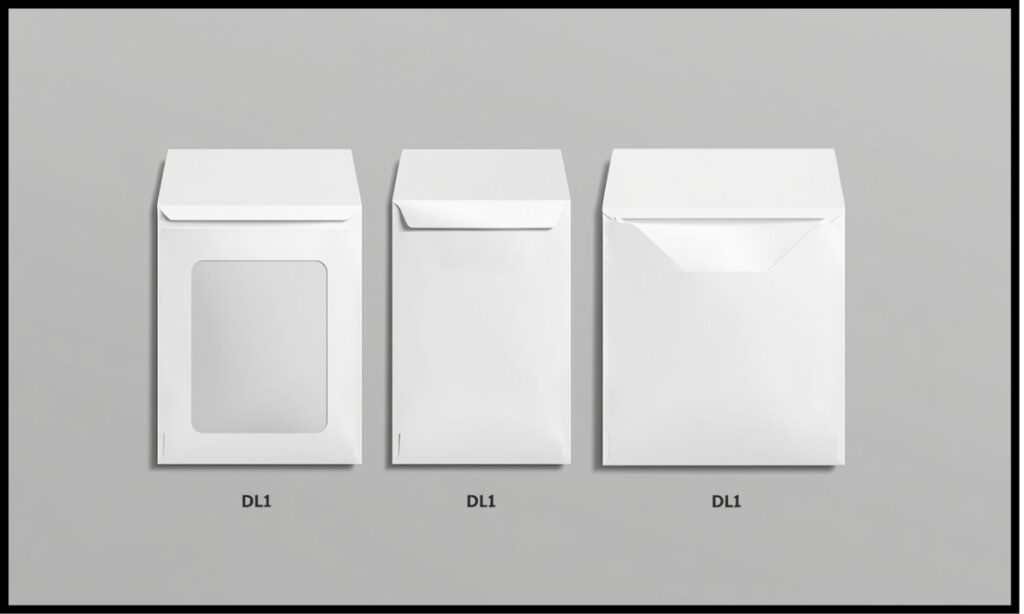
The DL window envelope is especially common in the UK and other regions that use ISO-based paper formats. A DL envelope measures approximately 110 × 220 mm.
Its proportions make it particularly suitable for an A4 sheet folded into thirds. This is one reason DL envelopes appear so often in business correspondence, invoices, statements, letters, and routine mailing.
A commonly referenced UK DL window measures around 93 × 39 mm. A typical placement is approximately 20 mm from the left and 53 mm from the top, although manufacturers may use slightly different specifications.
The exact DL window position matters because the address must align with the window after an A4 document has been folded. If the fold is even slightly different from the intended position, the address can move noticeably. Paper has a funny little habit of refusing to behave exactly like a computer screen.
DL Envelope Window Size and Position
When working with a DL envelope window size, think about two separate measurements: the opening itself and its location on the envelope.
A window around 93 × 39 mm provides enough space for several lines of address information. The location around 20 mm from the left and 53 mm from the top is a useful reference for a common UK-style DL format.
But there is no good reason to assume every DL envelope has identical window placement. Some envelopes are manufactured for specific postal systems or printing workflows, and their windows may be moved.
Before designing an address block, measure the actual envelope or download the manufacturer’s window envelope template. Five minutes spent checking the physical envelope can save an afternoon of adjusting a document that was printed 300 times already.
C4, C5, and C6 Window Envelopes
The ISO C series is widely used for matching envelopes to A-series paper. A C4 window envelope, for example, is large enough to hold an A4 sheet without folding.
A C5 window envelope is smaller and is generally associated with A5 paper or an A4 sheet folded in half. A C6 window envelope is smaller again and can accommodate A6 paper or appropriately folded material.
The envelope dimensions are:
- C4: 229 × 324 mm
- C5: 162 × 229 mm
- C6: 114 × 162 mm
These are overall envelope dimensions, not window openings. A C5 envelope might have a different window size or location depending on the manufacturer, so don’t confuse the envelope format with the window envelope dimensions.
Single-Window and Double-Window Envelopes
A single-window envelope has one transparent opening, most often intended for the recipient’s address. This is the familiar choice for invoices, statements, letters, and general business mail.
A double-window envelope has two transparent areas. The second window can be used for sender information, account details, promotional identification, or another printed field, depending on the envelope’s purpose.
The advantage of a double-window design is convenience, but it also demands greater precision. The folded document must line up with two separate openings instead of one, so the document template and envelope need to be designed as a pair.
For both styles, the window dimensions should leave enough visible space around important text. A little breathing room is useful, because addresses rarely sit perfectly still during folding and insertion.
Understanding Envelope Dimensions
When discussing window envelope sizes, it’s easy to focus entirely on the transparent rectangle and forget the rest of the envelope. Overall dimensions matter just as much.
An envelope’s width and height determine what documents it can hold. The flap determines how it closes. The opening direction affects how a printer may handle it. The paper weight influences how it folds and travels through mailing equipment.
Envelopes may be constructed as Open End envelopes, where the flap is on the short dimension, or Open Side envelopes, where the flap is positioned along the long dimension.
There are also different flap styles, including pointed and flat designs. These may not change the window itself, but they can affect the usable printing area and the way the envelope travels through a printer.
Common US Envelope Formats
US envelope naming can seem like a small alphabet soup with numbers thrown in for decoration. Commercial envelopes include formats such as #6 ¼, #6 ¾, #7 ¾, #8 ⅝, #9, #10, #11, #12, and #14.
Announcement envelopes include A-2, A-6, A-7, A-8, and A-10 formats. Baronial envelopes include sizes such as Baronial #2, #4, #5, #5 ¼, #5 ½, #5 ¾, and #6.
Booklet envelopes are another group, with formats including Booklet #3, #5, #6, #6 ½, #7, #7 ½, #9, #9 ½, #10, and #13.
Catalog envelopes are generally designed for bulkier materials and include formats such as Catalog #1, #1 ¾, #2, #3, #6, #7, #8, #9 ½, #9 ¾, #10 ½, #12 ½, #13 ½, #14 ¼, and #14 ½.
Not every one of these formats is necessarily manufactured with a window. The point is that the envelope family and size should be identified before searching for a matching window envelope size chart.
Envelope Window Placement and Address Position
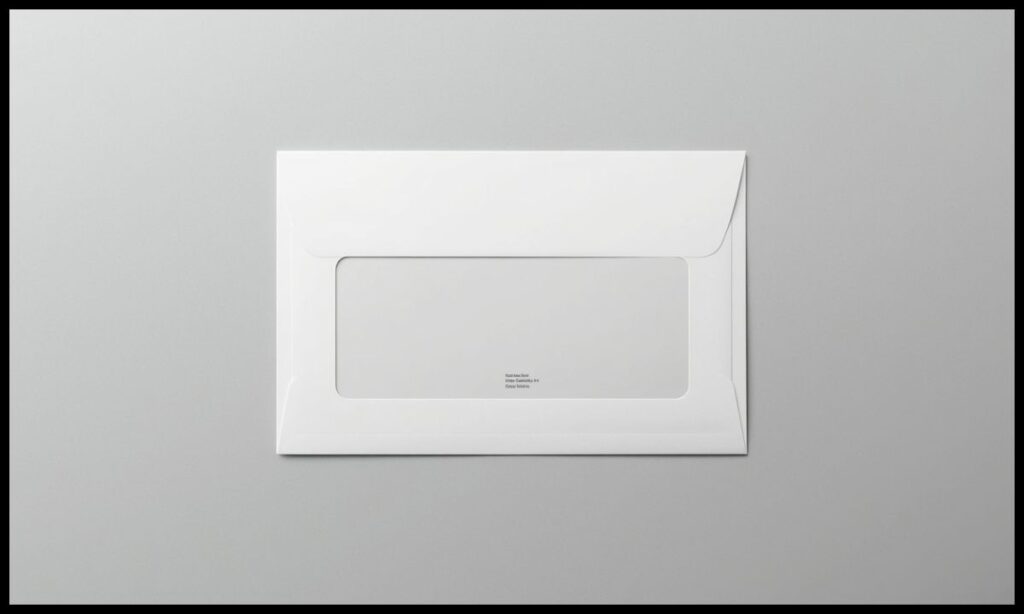
A correct window isn’t much use if the address lands somewhere else. Envelope window placement is therefore just as important as the size of the opening.
The address block should be positioned so that all essential information remains visible through the transparent area. This usually includes the recipient’s name, street address, city, region, and ZIP or postal code.
The design should also account for the way the document is folded. For a DL envelope, for instance, an A4 document is commonly folded into thirds. The address has to be printed in the correct zone before the paper is folded, otherwise the window may reveal a wonderfully empty patch of paper.
For professional printing, create a test copy and physically insert it into the envelope. Looking at the PDF on screen isn’t enough. The envelope doesn’t care what the screen promised.
Window Envelope Measurements for Printing
Printing on window envelopes involves more than choosing the correct page size in your printer settings. You need to consider the envelope’s orientation, printable area, flap construction, window material, and printer feeding method.
Both inkjet printers and laser printers can be used with suitable envelopes, but the manufacturer should confirm compatibility. Some window materials may not be designed for exposure to the heat produced inside certain laser printers.
Ink can also behave differently on coated or plastic window material. If printing directly onto an envelope, test the ink adhesion and drying time before committing to a large batch.
For this reason, many businesses print the address on the inserted document rather than printing directly over the envelope itself. The transparent window then simply reveals the already-printed address.
Address Window and Machine-Readable Mail
The address window is not merely decorative. Its position can support automated postal processing.
Modern mail systems can use optical character recognition (OCR) to interpret addresses and identify postal codes. Depending on the postal service and mailing format, barcodes may also be used to improve automated sorting and delivery.
That means keeping the address clear is practical, not just aesthetic. Avoid placing logos, graphics, decorative lines, or unnecessary text where they could interfere with the address zone.
For high-volume mail, businesses should consult the relevant postal service’s current addressing guidelines rather than relying only on a generic online measurement. Standards can change, and a template from ten years ago may be charmingly confident but still wrong.
How to Choose the Right Window Envelope
Start with the document you are mailing. Is it an unfolded A4 sheet, an A4 sheet folded into thirds, an A5 document, an invoice, a statement, or a thicker booklet?
Then select the appropriate envelope family. If you are using ISO sizes, the C series gives you a useful starting point. If you are mailing within the United States, commercial formats such as #10 may be more familiar.
Next, check the window envelope specifications. Look at the window width, height, left offset, top or bottom offset, and overall envelope dimensions.
Finally, test the actual folded document inside the actual envelope. This sounds almost too obvious, yet it catches mistakes that measurements on a computer simply can’t see.
Window Envelope Size Chart: What to Check
A useful window envelope size chart should contain more than just the envelope’s overall width and height. Ideally, it should show:
- Overall envelope dimensions
- Window width
- Window height
- Window position from the left edge
- Window position from the top or bottom edge
- Opening direction
- Flap style
- Suitable paper size
- Folding requirements
- Single or double window configuration
For example, knowing that a DL envelope is 110 × 220 mm tells you its outside size, but it doesn’t tell you exactly where a particular manufacturer’s window has been placed.
That distinction is important when creating templates. Envelope dimensions answer, “Will my paper fit?” Window measurements answer, “Will my address appear where it should?”
Envelope Window Placement for Business Mail
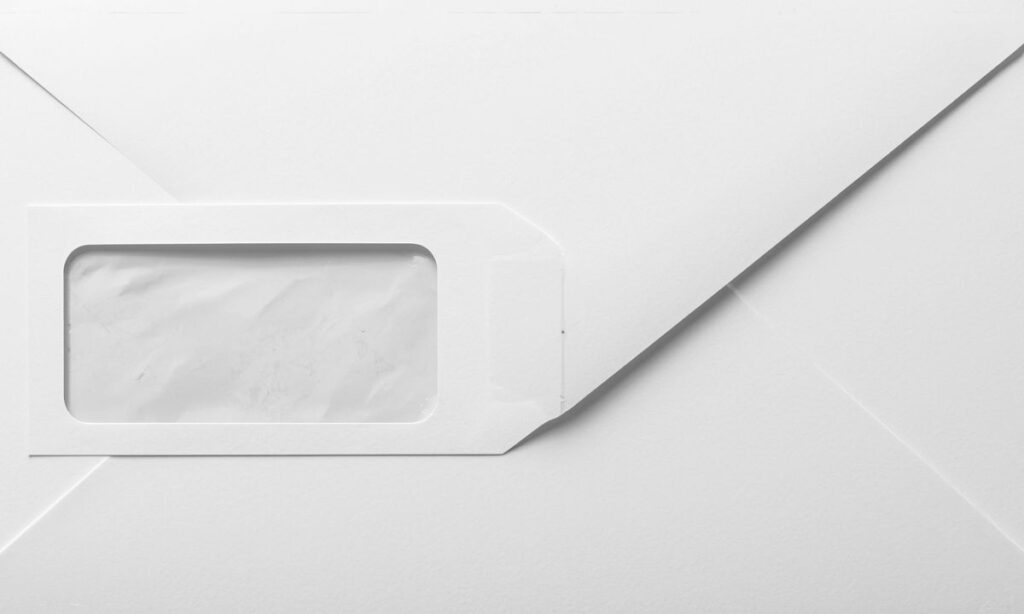
Business mail is where window envelopes really earn their keep. Invoices, statements, checks, bills, financial documents, letters, and direct marketing pieces can all benefit from address windows.
A properly prepared template allows the same design to be used repeatedly. Names and addresses change, but the layout remains fixed. This is especially useful when mailing software automatically inserts customer information into a document.
For businesses sending large quantities of mail, consistent address placement on envelopes can reduce manual labeling and make the whole mailing process faster.
Still, don’t sacrifice readability for automation. The best template is the one that quietly does its job without making the recipient squint at the plastic window.
Window Envelopes and Automatic Insertion
Some envelopes are manufactured specifically for automatic insertion equipment. These envelopes may have construction features designed to work smoothly with high-volume mailing machines.
This is another reason not to assume that every envelope with the same nominal size is identical. Two envelopes can share the same external dimensions while having different paper weights, flap configurations, window materials, or manufacturing tolerances.
If envelopes will be processed mechanically, check whether the manufacturer identifies them as suitable for automatic insertion. The tiny specifications can matter more than they first appear.
How to Create a Window Envelope Template
Creating an envelope window template starts with accurate measurements. Measure the envelope’s outside dimensions first, then measure the window itself.
Record the window’s distance from the left edge and from the top or bottom edge. Write these measurements down rather than trusting your memory, because nobody enjoys measuring the same envelope six times.
Then create the document layout using those measurements. Add the address block in the appropriate position and use realistic names and addresses during testing.
Print the template on ordinary paper before using actual envelopes. Fold the paper exactly as it will be folded during production and place it inside the envelope.
If the address is centered correctly and all information remains visible, you’re nearly there. If it is off by several millimeters, adjust the document rather than trying to force the envelope to cooperate.
Practical Tips for Accurate Window Envelope Printing
Always keep the manufacturer’s measurements available when designing a template. A generic standard window envelope size can be a useful starting point, but the physical envelope is the final authority for your particular batch.
Print one test copy before printing dozens or hundreds. Check the top, bottom, left, and right edges of the visible address area.
Keep important address information away from the very edge of the window. A small folding variation can shift the text and cause part of a postcode or ZIP code to become hidden.
If using a laser printer, verify that the window material is suitable for the printer’s heat. If using an inkjet printer, test drying and smudge resistance.
And one last practical thing: keep the envelope orientation correct. Printers have their own strange little personalities, and feeding an envelope the wrong way can turn a clean template into modern art.
Read more : DL Envelope Window Size and Position
Frequently Asked Questions
What is the standard window envelope size?
There isn’t one universal size. A commonly referenced US single-window opening is around 1 ⅛ × 4 ½ inches, while a UK DL window is often around 93 × 39 mm. Actual specifications vary by envelope manufacturer and format.
What is the size of a DL window envelope?
A DL envelope itself is approximately 110 × 220 mm. A commonly used DL window measures around 93 × 39 mm, with a typical placement around 20 mm from the left and 53 mm from the top.
Where should the window be on an envelope?
The correct envelope window position depends on the envelope format and manufacturer. Common specifications provide precise offsets from the left, top, or bottom edge, so the manufacturer’s template is the safest reference.
What is a single-window envelope?
A single-window envelope contains one transparent opening, usually designed to display the recipient’s mailing address from the document inside.
What is a double-window envelope?
A double-window envelope contains two transparent openings. Depending on the design, one can show the recipient’s address while another displays sender or account information.
Are C4, C5, and C6 window envelopes the same size?
No. C4, C5, and C6 are different ISO envelope formats. Their dimensions are approximately 229 × 324 mm, 162 × 229 mm, and 114 × 162 mm respectively.
Can I print addresses on window envelopes?
Yes, depending on the envelope and printer. However, many window envelopes are designed so that the address is printed on the enclosed document and viewed through the window, which can be simpler and more reliable.
Why does window position matter?
The address window placement determines whether the recipient’s details remain visible after the document is folded and inserted. Incorrect placement can hide important parts of the address or interfere with postal processing.
Conclusion
Understanding window envelope sizes is really an exercise in precision. The outside dimensions tell you what the envelope can hold, while the window dimensions and position determine whether your carefully prepared address will actually appear in the right place.
US commercial formats, ISO C-series envelopes, and DL envelopes all have their own conventions. A DL envelope may use a window around 93 × 39 mm, while a commonly referenced US single window is around 1 ⅛ × 4 ½ inches. These figures are useful references, but individual manufacturers can vary.
For the most dependable results, measure the actual envelope, check the manufacturer’s specification, create a template, and test one folded document before starting the full mailing run.
A well-designed window envelope is almost invisible in the best possible way. The paper fits, the address appears neatly, the postal information is easy to read, and the whole thing simply works. That’s the quiet magic of getting envelope window dimensions and window envelope placement right.