

An envelope can look like a very ordinary piece of paper until you need one that fits a particular card, document, or printed design exactly. Then suddenly, a few centimeters matter. The 9 Envelope is one of those numbered formats where its specific proportions make it useful for particular communication and printing needs, and knowing its measurements can save a surprising amount of trial and error.
The 9 envelope size is listed as 9.91 × 22.61 cm, or approximately 3.9 × 8.9 inches. That long, slim shape gives it a distinctive appearance compared with squarer invitation envelopes or larger document mailers. It is a small detail, but it changes how a card sits inside and how a printed address looks on the front, quite a bit.
Whether you’re comparing commercial envelope sizes, preparing artwork for printing, or simply trying to understand a numbered envelope chart, the 9 Envelope has several useful measurements worth knowing. So lets unfold the whole thing, one dimension at a time.
What Is a 9 Envelope?
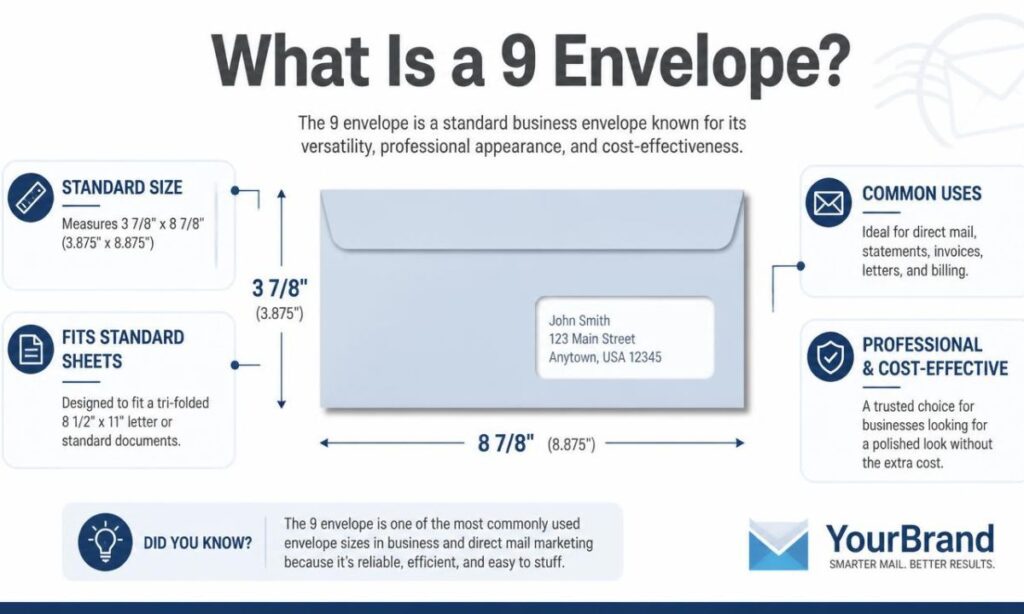
The 9 Envelope is a numbered envelope format associated with the US Commercial Envelope family. Commercial envelopes are generally designed around practical correspondence, mailing, cards, and business communication rather than large documents or bulky contents.
Its dimensions are 9.91 × 22.61 cm or 3.9 × 8.9 inches. The unusual length-to-width relationship makes the format noticeably wider in one direction than the other, creating that classic long-envelope character that feels made for a narrow letter or card.
When people search for 9 envelope dimensions, they are usually looking for one of three things: the exact physical size, the equivalent measurement in another unit, or its position among other numbered envelope formats. All three are useful when you’re planning a print job.
The format can also be described as a 9 envelope format card when a card or correspondence piece is designed specifically to fit inside it. This is where envelope sizing stops being just a number and becomes a practical design decision, really.
9 Envelope Size and Dimensions
The core measurement to remember is simple: the 9 envelope dimensions are 9.91 × 22.61 cm. In inches, this becomes approximately 3.9 × 8.9 inches.
For someone working in centimeters, the 9 envelope size in centimeters is therefore 9.91 cm by 22.61 cm. For a designer or printer working in inches, the 9 envelope size in inches is approximately 3.9 inches by 8.9 inches.
| Measurement | 9 Envelope |
|---|---|
| Width | 9.91 cm |
| Length | 22.61 cm |
| Width in inches | 3.9 inches |
| Length in inches | 8.9 inches |
| Area | 223.94 cm² |
| Area in square inches | 34.71 inch² |
| Perimeter | 65.02 cm |
| Perimeter in inches | 25.6 inches |
| Diagonal length | 24.68 cm / 9.72 inches |
| Aspect ratio | 39/89 |
These figures make the 9 envelope measurements fairly easy to compare with other formats. Just remember that manufacturing tolerances, flap construction, and usable interior space can vary between suppliers, so the listed outside size isn’t always identical to the exact printable or insertable area.
9 Envelope Size in Inches
For anyone working with US-style specifications, the 9 envelope dimensions in inches are approximately 3.9 × 8.9 inches. This is the measurement most useful when preparing artwork in an inch-based design program.
The 3.9 × 8.9 inch envelope has a slim horizontal proportion. It isn’t simply a miniature version of every other commercial envelope; its particular proportions give it a recognizable shape within a numbered envelope collection.
When preparing a card for a 3.9 × 8.9 inch envelope, don’t make the card exactly the same size as the envelope. A little clearance is needed so the insert can slide in without bending, scraping the edges, or becoming a tiny paper wrestling match.
Designers should also consider the flap and fold construction. The external envelope dimensions describe the overall envelope, while the usable interior dimensions can be slightly different because paper folds and seams take up space.
9 Envelope Size in CM
The 9 envelope size in cm is 9.91 × 22.61 cm. This measurement is particularly handy when creating templates for stationery, cards, or personalized correspondence in metric-based design systems.
The 9.91 × 22.61 cm envelope has an area of 223.94 cm². That figure describes the approximate rectangular area represented by the stated width and length, rather than the amount of paper you can actually print on.
If you’re ordering envelopes from a printer, providing both centimeters and inches can prevent misunderstandings. Paper suppliers don’t always describe sizes in exactly the same measurement system, and one tiny conversion mistake can create a whole stack of envelopes that are, well, not quite what you imagined.
Understanding the 9 Envelope Aspect Ratio
The 9 envelope aspect ratio is given as 39/89. In simple terms, the ratio compares the shorter dimension with the longer dimension and describes the envelope’s overall shape.
An aspect ratio is useful because it tells you something about the geometry without requiring the complete dimensions. Two envelopes could have different physical sizes but similar proportions, while two envelopes with the same length could look very different if their widths aren’t alike.
For the 9 Envelope, the 39/89 aspect ratio reflects its long and narrow format. This matters in graphic design because a layout created for a wide rectangular envelope won’t automatically look balanced on this shape.
The aspect ratio also helps explain why certain cards feel naturally suited to this envelope. A long address block, horizontal greeting, or narrow folded insert can visually belong inside the format instead of looking squeezed into it.
9 Envelope Area
The 9 envelope area is approximately 223.94 cm², or 34.71 inch². Area is calculated from the envelope’s basic rectangular dimensions, so it provides a simple way of understanding the surface represented by the width and length.
This number can be useful when comparing paper formats, estimating material requirements, or discussing the physical footprint of the envelope. Still, it shouldn’t be confused with the printable area, because flaps, seams, folds, and margins may reduce the practical design space.
For printing projects, the front panel is usually more important than the theoretical total area. A designer might have plenty of paper mathematically, but only a portion of it may be suitable for an address, logo, or decorative artwork. Paper geometry loves making things slightly more complicated than they first appear.
9 Envelope Perimeter
The 9 envelope perimeter is approximately 65.02 cm, or 25.6 inches. Perimeter simply means the total distance around the four sides represented by the basic dimensions.
This measurement isn’t normally the first thing someone needs when purchasing envelopes, but it can be useful in technical comparisons and geometry-based calculations. It gives another way to describe the overall size of the format.
Knowing the perimeter can also help when comparing differently proportioned rectangular formats. Two envelopes may have similar areas but noticeably different perimeters, especially when one is long and narrow. The 9 Envelope definitely falls into the long-and-narrow camp.
9 Envelope Diagonal Length
Another useful geometric measurement is the 9 envelope diagonal, which is approximately 24.68 cm, or 9.72 inches.
The diagonal runs from one corner of the rectangular envelope to the opposite corner. It is calculated using the width and length together, making it a handy geometric reference rather than a measurement normally used for everyday mailing.
The envelope diagonal length can be especially interesting when comparing whether a particular flat insert could theoretically fit diagonally. Of course, real envelopes have seams and openings, so mathematical possibility and practical usability aren’t always best friends.
Where the 9 Envelope Fits in the US Commercial Envelope Series
The US Commercial Envelope series contains several numbered formats, and the numbers distinguish different sizes rather than simply indicating a universal increase from one envelope to the next.
Related formats include the 16 Envelope, 14 Envelope, 12 Envelope, 11 Envelope, 10 Envelope, 9 Envelope, 8.625 Envelope, 7.75 Monarch Envelope, 7 Envelope, 6.75 Envelope, and 6.25 Envelope.
A simplified comparison from the supplied measurements looks like this:
| Envelope | Approximate dimensions |
|---|---|
| 16 Envelope | 6 × 12 inches |
| 14 Envelope | 5 × 11.5 inches |
| 12 Envelope | 4.8 × 11 inches |
| 11 Envelope | 4.5 × 10.4 inches |
| 10 Envelope | 4.1 × 9.5 inches |
| 9 Envelope | 3.9 × 8.9 inches |
| 8.625 Envelope | 3.6 × 8.6 inches |
| 7.75 Monarch Envelope | 3.9 × 7.5 inches |
| 7 Envelope | 3.7 × 6.8 inches |
| 6.75 Envelope | 3.6 × 6.5 inches |
| 6.25 Envelope | 3.5 × 6 inches |
This kind of envelope size chart is useful when selecting a format because the differences may look tiny on paper but become obvious once a card or sheet is inserted.
The 9 Envelope sits among these numbered commercial envelope sizes, giving designers and stationery users another option between neighboring formats. The exact choice depends on the insert and the desired visual proportion, not merely which number sounds right.
9 Envelope Format and Card Compatibility
A 9 envelope format can work particularly well with cards designed around its long rectangular proportions. The important thing is to consider the insert’s finished size rather than only looking at the envelope from the outside.
A card that is too close to the envelope’s internal dimensions can be frustrating. It may technically fit, but putting it inside becomes a slow little ceremony involving corners, fingertips, and mild regret. A modest amount of clearance makes the experience much nicer.
For folded cards, remember to measure the folded dimensions. A sheet may begin at a much larger size, but after folding, its final width and height determine whether it belongs inside the envelope.
This is also why card envelope size should be considered at the beginning of a stationery project, rather than after the card design has already been printed. Choosing the envelope first can save paper, time, and a rather unnecessary redesign.
Printing on a 9 Envelope
Printed envelopes can turn ordinary correspondence into something much more deliberate. The 9 Envelope can carry addresses, business information, decorative artwork, event details, or personalized designs depending on the purpose.
Before printing, check the printer’s supported envelope dimensions and feeding method. Not every inkjet or laser printer handles narrow envelopes in exactly the same way, and some printers require special manual-feed settings.
Create the artwork using the actual 9 envelope dimensions, but leave safe margins around the edges. The flap, seams, folds, and printer feed direction all deserve attention before the first expensive batch goes through the machine.
A test print on plain paper is a smart little trick. Place the test sheet over the envelope or compare the printed position against a blank envelope before committing to the whole stack. Five minutes here can save an afternoon later.
Designing a 9 Envelope for Business Correspondence
The commercial envelope category is strongly connected with practical communication, including business letters, invoices, notices, cards, and other correspondence. A clean design usually works better than covering every available inch with decoration.
A company name, return address, recipient information, and a restrained graphic element can create a professional appearance. The narrow shape of the 9 envelope format means alignment becomes especially important because there isn’t much visual width to waste.
For personalized printing, consider the relationship between text size and envelope dimensions. Tiny text may technically fit, but an address that needs a magnifying glass isn’t winning any design awards.
Comparing the 9 Envelope With Other Formats
An envelope size comparison becomes much easier when the dimensions are placed side by side. The 10 Envelope, for example, is listed at 4.1 × 9.5 inches, while the 9 Envelope is 3.9 × 8.9 inches.
The 8.625 Envelope is smaller at about 3.6 × 8.6 inches, while the 7.75 Monarch Envelope has dimensions of approximately 3.9 × 7.5 inches. These differences demonstrate that numbered envelopes are not interchangeable simply because their names appear close together.
The envelope dimensions chart is therefore more useful than relying on the number alone. If a card, letter, or printed piece has already been created, measure it first and then choose an envelope that provides appropriate clearance.
Common Uses for a 9 Envelope
The 9 Envelope can be considered for compact correspondence, cards, printed stationery, and other relatively narrow inserts. Its long profile can give even a simple message a polished presentation.
It may also be useful for personalized communication where appearance matters. A carefully designed envelope can make a small card feel like a tiny event before the recipient has even opened it, which is a surprisingly powerful thing for a rectangle of paper to accomplish.
For businesses, the format may be suitable when the correspondence or insert matches its proportions. For personal stationery, the same dimensions can support cards and notes that benefit from a horizontal presentation.
The key is always compatibility. The best commercial envelope size isn’t automatically the largest or smallest one; it’s the format that comfortably accommodates the intended contents while maintaining the appearance you want.
Quick 9 Envelope Size Guide
If you need the essential facts without wandering through the entire geometry lesson, keep these measurements nearby:
- 9 Envelope: the numbered envelope format discussed in this guide.
- 9 envelope size: 9.91 × 22.61 cm.
- 9 envelope size in inches: approximately 3.9 × 8.9 inches.
- 9 envelope size in cm: 9.91 × 22.61 cm.
- 9 envelope dimensions in inches: approximately 3.9 × 8.9 inches.
- 9 envelope dimensions in cm: 9.91 × 22.61 cm.
- 9 envelope area: 223.94 cm².
- 9 envelope area in square inches: 34.71 inch².
- 9 envelope perimeter: 65.02 cm or 25.6 inches.
- 9 envelope diagonal: 24.68 cm or 9.72 inches.
- 9 envelope aspect ratio: 39/89.
- Format: part of the US Commercial Envelope and numbered-envelope family.
Having these figures together makes envelope sizing much less mysterious. No ruler gymnastics required, thankfully.
Tips for Choosing the Right 9 Envelope
Start by measuring the finished insert. If it is a folded card, measure it after folding, because that is the actual object that needs to enter the envelope.
Next, compare the insert with the internal dimensions rather than assuming the outside measurements tell the whole story. Construction details can reduce the usable space slightly, and different manufacturers may have small variations.
If printing directly onto the envelope, check your printer before buying a large quantity. Paper feeding, envelope thickness, printable margins, and orientation can all affect the result.
Finally, order or test a small quantity first when possible. A physical sample tells you things a spreadsheet doesn’t, especially how easily the card slides in and how the finished design looks in someone’s hand.
Why Accurate Envelope Measurements Matter
Accurate envelope measurements are important because envelopes are both functional objects and visual objects. A card needs enough room to enter comfortably, while printed elements need enough room to remain readable and properly positioned.
For designers, accurate envelope paper dimensions make templates more reliable. For printers, they reduce setup mistakes. For ordinary stationery users, they simply prevent the irritating discovery that the envelope they bought is almost right—but not quite.
The small details add up. Width, height, aspect ratio, area, perimeter, and diagonal length each describe a different part of the same object. Together, they give a much clearer picture of the 9 envelope than the number alone ever could.
Read more : Window Envelope Sizes
Frequently Asked Questions
What Is a 9 Envelope?
A 9 Envelope is a long, narrow envelope format commonly used for cards, invitations, announcements, and personal correspondence.
What Are the Dimensions of a 9 Envelope?
The 9 Envelope measures approximately 3.9 × 8.9 inches (9.91 × 22.61 cm), giving it a slim and elegant appearance.
What Can You Put in a 9 Envelope?
It is suitable for greeting cards, letters, small invitations, photographs, and other lightweight documents that fit its long format.
How to Choose the Right 9 Envelope?
Consider the size of your card or paper, the thickness of the contents, and the desired paper quality before selecting a 9 Envelope.
Conclusion
The 9 Envelope may be a modest paper product, but its dimensions tell an interesting little story about how stationery is designed. At 9.91 × 22.61 cm, or approximately 3.9 × 8.9 inches, it has a distinctive long shape that places it within the broader US Commercial Envelope family.
Its 39/89 aspect ratio, 223.94 cm² area, 65.02 cm perimeter, and 24.68 cm diagonal length provide useful geometric references, while the comparisons with other numbered formats help explain where it sits among standard commercial envelope options.
Most importantly, the right envelope begins with the right measurement. Whether you’re preparing a card, setting up printed correspondence, or building a professional stationery template, knowing the 9 envelope size before designing saves trouble later.
A good envelope doesn’t merely hold a message. It gives the message its first shape, its first impression, and sometimes that little paper rectangle says, before anything is read, that someone cared enough to get the details right.