
When someone asks “How big is 24 x 36?”, they are usually trying to picture a piece of paper, a poster, a print, or another large-format item before ordering or creating it. The numbers look simple, but seeing the actual size in your head can be a little tricky, honestly.
A 24 x 36 sheet is a substantial rectangular format, measuring 24 x 36 inches. In metric measurements, that becomes 60.96 × 91.44 cm, so it is wide enough for a noticeable wall poster while still being a practical size for many printing projects.
Whether you’re checking 24×36 dimensions, planning a poster, comparing paper formats, or preparing artwork for a printing press, knowing the measurements makes the whole process much easier. Let’s unpack the size piece by piece.
How Big Is 24 x 36 in Inches?
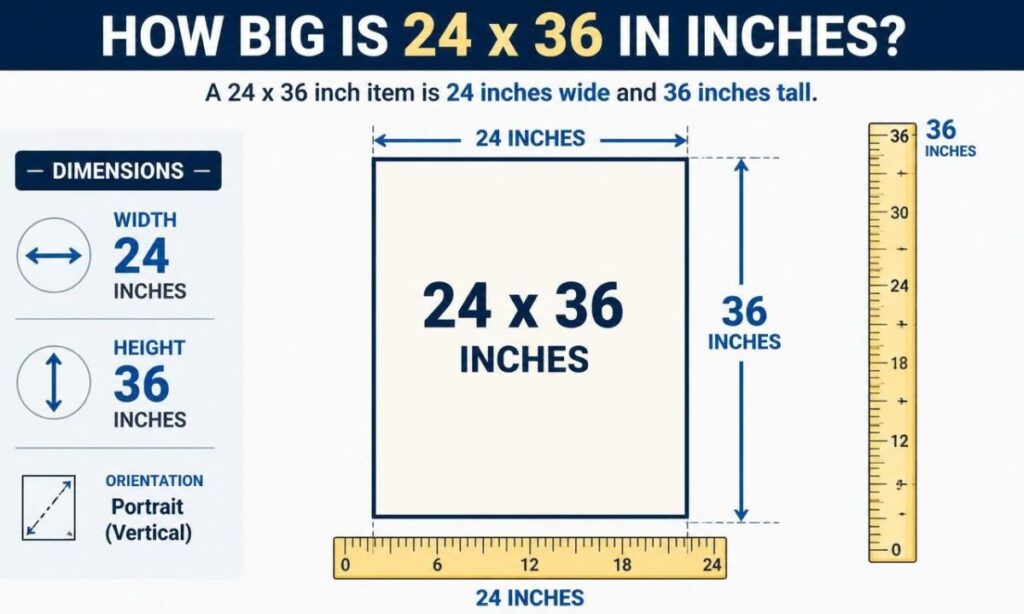
The easiest answer to how big is 24 x 36 is simply 24 inches by 36 inches. The shorter side measures 24 inches, while the longer side measures 36 inches, giving the sheet a clearly rectangular shape.
That means the 24×36 size is twice as long as it is wide? Not quite the relationship is 36 ÷ 24 = 1.5, which gives it a 2/3 aspect ratio. That proportion is useful when designing artwork because the same shape can be maintained across different dimensions.
In everyday terms, a 24 by 36 size is considerably larger than standard office paper. If you place a regular letter-size sheet on it, the difference becomes pretty obvious, and suddenly that little office printer sheet looks almost shy sitting beside it.
- Width: 24 inches
- Height: 36 inches
- Dimensions: 24 × 36″
- Shape: Rectangle
- Aspect ratio: 2/3
- Long side: 36 inches
- Short side: 24 inches
So, if you’re wondering how big is a 24×36, imagine a large rectangular poster designed to be read or viewed from several feet away. That’s roughly the visual territory we’re talking about.
24×36 Dimensions in Centimeters
For anyone working with metric measurements, the 24×36 dimensions in centimeters are 60.96 × 91.44 cm. The conversion is straightforward because one inch equals 2.54 centimeters.
The shorter measurement is 60.96 cm, while the longer measurement is 91.44 cm. Those numbers may look less intuitive at first, but together they describe exactly the same physical sheet.
For printing companies, designers, architects, and anyone preparing artwork internationally, knowing both systems is useful. A printer may ask for inches while design software displays centimeters, so having the conversion handy prevents a surprisingly annoying mistake.
The basic 24×36 conversion is:
- 24 inches × 2.54 = 60.96 cm
- 36 inches × 2.54 = 91.44 cm
- Therefore, 24×36 in cm = 60.96 × 91.44 cm
So if somebody asks, “How big is 24×36 in centimeters?”, the short answer is 60.96 × 91.44 cm.
24×36 Paper Size and Its Physical Shape
The 24×36 paper size has a clean rectangular proportion that works especially well for visual material. Its dimensions give designers enough room for large headlines, photographs, diagrams, illustrations, and other content without making the page ridiculously oversized.
The 24×36 sheet can be positioned vertically or horizontally depending on the project. In portrait orientation, 24 inches is the width and 36 inches is the height. Turn it sideways and the same physical dimensions become 36 inches wide and 24 inches tall.
This flexibility is one reason the 24 x 36 paper format appears in different printing situations. A landscape layout might suit a wide graphic, while portrait orientation can feel more natural for a traditional poster.
There isn’t any secret extra measurement hiding between the numbers, either. The 24×36 measurements refer directly to the two sides of the sheet.
What Is the 24×36 Aspect Ratio?
The 24×36 aspect ratio is 2/3, or 2:3 when written as a width-to-height relationship. This means that for every 2 units across, there are 3 units vertically.
Aspect ratio matters because it determines the shape of an image or printed design. If your artwork has the wrong ratio, stretching it to fit the sheet can make people, objects, or graphics look oddly wider or taller than intended, which is rarely the artistic surprise anyone wanted.
For example, an image designed specifically for a 2/3 aspect ratio can fit a 24×36 format naturally. Other images may need cropping before being printed.
The ratio can be simplified from 24:36 by dividing both numbers by 12:
24 ÷ 12 = 2
36 ÷ 12 = 3
Therefore, the 24×36 format has a 2/3 aspect ratio.
What Is the Area of a 24×36 Sheet?
If you’re asking what is the area of a 24×36 sheet, the calculation is wonderfully simple. Multiply the width by the height.
24 × 36 = 864 square inches.
So the 24×36 area is 864 square inches.
Converted into metric units, the area is approximately 5,574.18 cm². This gives you a useful idea of how much physical surface is available for printing, artwork, graphics, or other content.
The measurements are:
- Area: 864 square inches
- Area: 5,574.18 cm²
- 24×36 square inches: 864 in²
- 24×36 area in metric: 5,574.18 cm²
When calculating paper requirements, the area can be particularly helpful. A large design with lots of visual information needs enough surface area to breathe, and this format gives it quite a bit.
What Is the Perimeter of 24×36?
The 24×36 perimeter is the total distance around all four edges of the rectangle. To calculate it, add the two dimensions and multiply by two.
2 × (24 + 36) = 120 inches.
Therefore, the perimeter is 120 inches, which equals 304.8 cm.
That gives you:
- 120 inch perimeter
- 304.8 cm perimeter
This measurement can be useful when thinking about framing, borders, mounting materials, or edge treatments. If you’re cutting a border around a 24 x 36 print, for example, the perimeter tells you the total length around the outside edge.
It isn’t normally the first number people need, but once you’re working with physical materials, these little details suddenly matter a lot.
What Is the Diagonal of a 24×36 Sheet?
The 24×36 diagonal is the straight-line distance from one corner of the sheet to the opposite corner. You can calculate it using the Pythagorean theorem.
The calculation is:
√(24² + 36²) ≈ 43.27 inches
In centimeters, that is approximately 109.9 cm.
So the diagonal length of a 24×36 sheet is about 43.27 inches, or 109.9 cm.
This number can be useful when checking whether a sheet will fit through a particular opening or when comparing the visual size of rectangular formats. The diagonal is longer than either side, naturally, but seeing the actual figure makes the sheet easier to imagine.
Is 24×36 a Standard Paper Size?
The answer depends on what you mean by “standard.” 24×36 inches is a commonly encountered large paper and printing dimension, particularly in poster and large-format applications, but it is not one of the everyday office paper sizes like US Letter.
It can also appear in the context of the Common US Press Sheet family. Press sheets are available in many dimensions, and printers select them according to the job, equipment, finishing requirements, and how efficiently smaller pieces can be imposed onto a larger sheet.
Some related common US press sheet sizes include:
- 38×50 inches
- 35×45 inches
- 28×40 inches
- 26×40 inches
- 25×38 inches
- 24×36 inches
- 23×35 inches
- 23×29 inches
- 20×26 inches
- 19×25 inches
- 17×22 inches
- 12×18 inches
- 11×17 inches
These formats don’t all have the same proportions, so comparing only their widths and heights can be a little misleading. Their paper aspect ratio and intended printing applications matter too.
24×36 as a Common US Press Sheet
A 24×36 Common US Press Sheet can be useful in commercial printing because larger sheets allow printers to arrange multiple smaller pieces on one sheet. This process, often called imposition, helps organize the printing job before cutting and finishing.
The exact choice of press sheet depends on the printing press and the finished product. A printer might use a larger sheet to produce several smaller pieces, while a direct 24×36 print may be the finished format itself.
For people preparing artwork, understanding US press sheet dimensions can prevent problems with bleed, trim, margins, and crop marks. A design that looks perfect on screen can become troublesome if its physical dimensions don’t match the printer’s specifications.
That’s why asking the printer for the exact template before sending a large-format job is a smart move. Tiny details on screen become very real once ink meets paper.
24×36 Poster Size: How Large Is It?
The 24×36 poster size is large enough to make a strong visual impression without becoming enormous. It is often suitable for wall displays, announcements, artwork, promotional graphics, event information, and other designs that need to be seen from a reasonable distance.
A 24 x 36 poster can carry a large photograph with supporting text, or it can be designed around typography and graphics. The available 864 square inches give designers plenty of room to create hierarchy between headings, images, and smaller information.
For a poster, viewing distance matters. Text that looks perfectly readable on a laptop may become too small once placed on a wall. With this format, designers generally have enough room to use larger typography rather than squeezing everything into a crowded rectangle.
24×36 Print Size for Printing Projects
The 24×36 print size works for many kinds of visual projects because it sits comfortably within the world of large-format printing. It can be used for photographs, artwork, informational displays, maps, presentations, and promotional materials.
A print shop may treat the format differently depending on the equipment and material. Paper, cardstock, photo media, adhesive stock, and other printing materials can all behave differently during production.
If you’re ordering a 24×36 print, check whether the quoted dimensions refer to the final trimmed size or the full sheet size. That one question can save you from losing part of a design at the trimming stage, which is a very un-fun discovery.
24×36 for Posters, A3 Printing, and Large Formats
The 24×36 format is much larger than A3, so it should not be confused with A3 printing. A3 measures 29.7 × 42 cm, while 24×36 measures 60.96 × 91.44 cm.
That difference is substantial. A3 is useful for smaller posters, documents, presentations, and artwork, whereas a 24×36 poster provides a much larger canvas for viewing at a distance.
When a project needs more space than A3 can provide, designers may move toward larger formats such as 24×36. From there, other large paper sizes and large format paper options are available depending on the purpose.
The important thing is not to assume that every large sheet is interchangeable. The dimensions, aspect ratio, material, and printing equipment all affect the finished result.
Creative Uses for a 24×36 Sheet
A 24×36 sheet can become much more than a plain rectangle of paper. Its generous dimensions make it suitable for creative and commercial work where visibility matters.
Common uses can include:
- Posters for events, announcements, or displays
- Art prints and photographic enlargements
- Presentation graphics and visual boards
- Maps and diagrams
- Promotional displays
- Advertising stickers when produced on suitable adhesive media
- Promotional banners and related display graphics
- Custom printing projects
- Large artwork and decorative wall prints
The exact application depends on the material and printing process. A paper poster and an outdoor promotional banner might share similar dimensions while requiring completely different production methods.
24×36 Compared With Other Paper Formats
Comparing 24×36 with other sizes is useful when you’re unsure how large your final project should be. The 24×36 format is notably larger than everyday office sheets and substantially larger than A3.
Some related formats have different proportions, too. For example, the aspect ratios associated with various press-sheet dimensions may include 19/25, 7/9, 7/10, 13/20, 25/38, 23/35, 23/29, 10/13, 17/22, and 11/17.
This matters because two sheets can have similar areas but produce very different visual compositions. A photograph that fits one proportion beautifully may require cropping on another.
For anyone comparing 24×36 compared with other US press sheet sizes, it helps to look at both the physical dimensions and the paper aspect ratio, rather than focusing on just one number.
Inches to Centimeters Conversion for 24×36
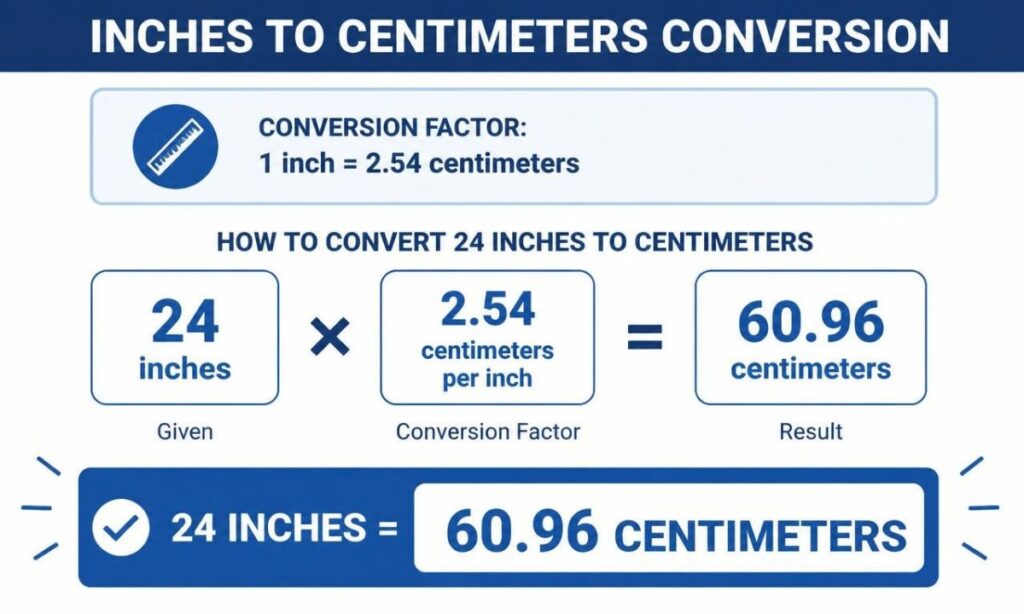
If you’re working between American and metric specifications, the inches to centimeters conversion for 24×36 is worth keeping nearby.
The formula is simple:
Inches × 2.54 = centimeters
Using that formula:
- 24 inches = 60.96 cm
- 36 inches = 91.44 cm
- 24 × 36 inches = 60.96 × 91.44 cm
Going in the opposite direction uses:
Centimeters ÷ 2.54 = inches
This basic centimeters to inches conversion is useful when a design brief is written in centimeters but the printing service lists available sizes in inches. No complicated calculator gymnastics required.
How to Prepare a 24×36 Design for Printing
Before sending a 24×36 print to a printer, check the document dimensions first. Set the canvas to the intended final size instead of designing at an unrelated size and hoping it scales correctly.
For a 24×36 printing size, the document should generally match the required final dimensions, while resolution, bleed, color mode, and file format should follow the printer’s specifications.
If the printer requests bleed, include it outside the final trim area. Keep important text and logos safely inside the trim boundary too. Otherwise, something that looked comfortably positioned on screen might get clipped during finishing.
For photographs or detailed artwork, also consider image resolution. Enlarging a low-resolution image to a large 24×36 print size can reveal softness, pixelation, or compression artifacts.
Common Mistakes With 24×36 Measurements
One common mistake is confusing width and height with area. 24 × 36 inches describes the dimensions, while 864 square inches describes the area. They are related, but they are not interchangeable.
Another mistake is assuming that every 24×36 item has exactly the same usable area. A finished poster may have trim, bleed, borders, mounting space, or framing that changes the portion available for the actual artwork.
People also sometimes mix inches and centimeters without converting them properly. Remember that 24 inches is 60.96 cm, not 60.96 inches, and 36 inches is 91.44 cm.
Finally, don’t rely only on the name of a format when ordering printing. Always confirm the actual 24×36 sheet dimensions with the printer, especially when the project involves custom materials or finishing.
Quick 24×36 Measurement Guide
If you just need the important numbers, this compact guide answers most common questions about the 24×36 size.
- 24×36 dimensions: 24 × 36 inches
- 24×36 size in cm: 60.96 × 91.44 cm
- Width: 24 inches / 60.96 cm
- Height: 36 inches / 91.44 cm
- Aspect ratio: 2/3
- Area: 864 square inches
- Area in metric: 5,574.18 cm²
- Perimeter: 120 inches / 304.8 cm
- Diagonal: 43.27 inches / 109.9 cm
- Orientation: Portrait or landscape
- Typical uses: Posters, artwork, displays, and large-format printing
So, when someone searches “What are the dimensions of 24×36?”, this is the essential answer: 24 inches by 36 inches, or 60.96 × 91.44 centimeters.
How Big Is a 24×36 Sheet in Real Life?
Numbers are useful, but physical comparison is often easier. A 24×36 sheet is large enough to dominate a wall section when displayed as a poster, yet it remains manageable for many professional printing applications.
Imagine holding a rectangular board that is two feet wide and three feet tall. That’s the easiest everyday mental picture for 24 by 36 inches. Turn it sideways and you have a three-foot-wide, two-foot-high rectangle.
That size gives you a nice middle ground between ordinary paper and truly massive signage. It feels substantial without requiring an enormous amount of wall space, which is probably why the format keeps showing up in poster and display work.
Read more : Medidas A1
Frequently Asked Questions
How Big Is 24 x 36 in Inches?
A 24 x 36 size measures 24 inches by 36 inches, making it a large rectangular format suitable for posters and prints.
How Big Is 24 x 36 in Centimeters?
A 24 x 36 sheet measures approximately 60.96 × 91.44 cm, giving you a clear metric equivalent.
What Is the Area of 24 x 36?
The total area is 864 square inches, or about 5,574.18 cm², providing plenty of space for large designs.
What Is a 24 x 36 Sheet Used For?
A 24 x 36 sheet is commonly used for posters, artwork, photographs, displays, and large-format printing.
Conclusion
So, how big is 24 x 36? It is 24 inches wide by 36 inches high, equivalent to 60.96 × 91.44 cm. Its 2/3 aspect ratio, 864-square-inch area, 120-inch perimeter, and approximately 43.27-inch diagonal give you a complete mathematical picture of the format.
For printing, the 24×36 paper size offers a generous canvas for posters, artwork, photographs, displays, and other large-format projects. It is especially useful when a design needs to be visible without stepping into truly gigantic signage territory.
Before printing, always confirm the printer’s specifications for bleed, resolution, margins, material, and final trim. The numbers may be simple, but getting those details right is what turns a correctly measured sheet into a correctly printed project.
And next time someone asks how large is 24×36, you won’t need to stare at the numbers wondering what they mean. Think two feet by three feet, or 60.96 by 91.44 centimeters a proper big rectangle, basically, with plenty of room for an idea to stretch its legs.