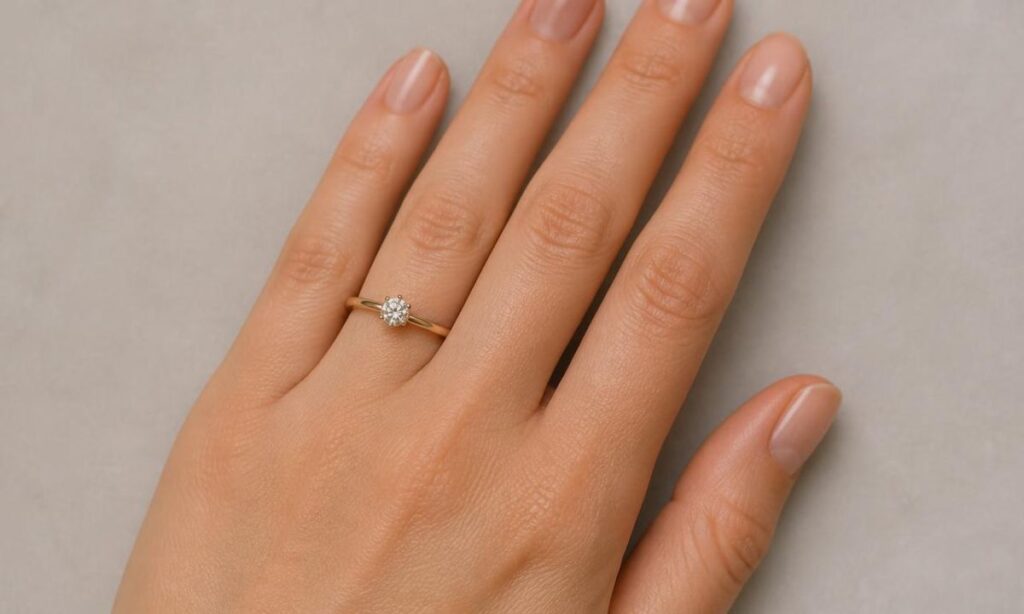
Buying a ring for yourself can be oddly simple until the little metal circle has to actually fit your finger. Then suddenly, a tiny number becomes a surprisingly important decision. Is your size 6 too small? Would a 7 slide around? And why does the same finger sometimes feel different from one day to the next? These are the sorts of questions that make ring sizing for women less straightforward than it first appears.
For many adult women in the United States, the average ring size for women is commonly reported around US size 6 to 7, with size 7 often described as a particularly common size. But “average” should never be treated as a universal answer. Finger proportions, genetics, age, temperature, time of day, and even the width of the ring can change how a particular size feels.
So if you’re trying to find your ring size, the average is best used as a starting clue, not a measurement carved into stone. Your own finger is the final authority, and thankfully, it is much easier to measure than most people expect.
What Is the Average Ring Size for Women?
The commonly cited average women’s ring size in the United States falls somewhere around US size 6 to 7. Size 7 is frequently mentioned as one of the more common sizes for adult women, although there isn’t one official worldwide “standard women’s ring size.”
That distinction matters. A woman can have slender hands and still wear a size 7, while someone with broader hands might comfortably wear a 6. Finger shape is wonderfully uncooperative like that.
The typical women’s ring size also varies depending on which finger you’re measuring. Your ring finger may not be the same size as your middle finger, index finger, or pinky. Even the two hands can differ slightly.
For that reason, the most common ring size for women should never replace an actual ring size measurement when accuracy matters, especially for an engagement ring or wedding band.
Average Ring Size for Women in the US
When people search for the average ring size for women in the US, they’re usually looking for a quick number they can use when purchasing a surprise ring. US sizes generally use numerical measurements, including whole and half sizes.
A practical starting point is US size 6 or 7, particularly when shopping for an adult woman’s ring without knowing her exact size. Still, choosing between those sizes based purely on averages is a bit like guessing someone’s shoe size from their hairstyle. It might work, but it isn’t exactly science.
If the ring is a gift, look for clues instead. An existing ring she wears on the same finger can provide a much better estimate. A trusted friend or family member may also know her size, and some jewelers can help you estimate it discreetly.
The safest option, whenever possible, is to determine ring size directly rather than relying on the population average.
Average Ring Size for Women by Finger
There is no single women’s finger size because every finger has its own dimensions. The ring finger is generally smaller than the middle or index finger for many people, while the pinky is usually considerably smaller.
A ring intended for the ring finger should therefore be measured specifically for that finger. Moving an existing ring from one finger to another and assuming the sizes match can produce a rather unfortunate surprise.
Finger shape matters too. Some fingers taper gradually toward the nail, while others are wider around the knuckle. A ring needs to pass over the knuckle but still sit comfortably at the base of the finger.
That is why a perfect ring fit is not simply about matching one number on a chart. It’s about how the ring behaves when your hand is moving, warm, relaxed, and doing normal everyday things.
Women’s Ring Size Chart: Understanding the Numbers
A women’s ring size chart connects a numerical ring size with measurements such as inner diameter and finger circumference. US charts commonly express sizes using numbers, while other countries may use different systems.
Here is a simplified reference for several commonly encountered US sizes:
| US Ring Size | Approx. Inner Diameter | Approx. Inner Circumference |
|---|---|---|
| 5 | 15.7 mm | 49.3 mm |
| 5.5 | 16.1 mm | 50.6 mm |
| 6 | 16.5 mm | 51.9 mm |
| 6.5 | 16.9 mm | 53.1 mm |
| 7 | 17.3 mm | 54.4 mm |
| 7.5 | 17.7 mm | 55.7 mm |
| 8 | 18.2 mm | 57.0 mm |
| 8.5 | 18.6 mm | 58.3 mm |
| 9 | 19.0 mm | 59.5 mm |
These figures are useful for understanding the relationship between size and physical dimensions, but a jeweler’s ring size chart may differ slightly in presentation or rounding.
If your measurement lands between sizes, don’t immediately panic. That’s actually pretty normal, especially when measuring at home.
How to Measure Ring Size at Home
You don’t necessarily need a jewelry store to measure ring size at home. A flexible measuring tape, thin strip of paper, string, and ruler can provide a useful estimate.
Wrap the string or paper gently around the base of the finger where the ring will sit. It should be snug without squeezing the skin. Mark where the ends meet, then lay the material flat against a ruler and measure the length in millimeters.
That number represents your approximate finger circumference. You can then compare it with a reliable ring size chart.
There is one little trap here: don’t pull the string extremely tight. A measurement that compresses the finger may make the resulting ring size unnecessarily small. Your ring should be secure, yes, but not behave like a tiny metal zip tie.
For the best result, measure the finger more than once. If the measurements vary, take several readings and look for the consistent range rather than trusting one hurried measurement.
How to Measure Ring Size Without a Ring
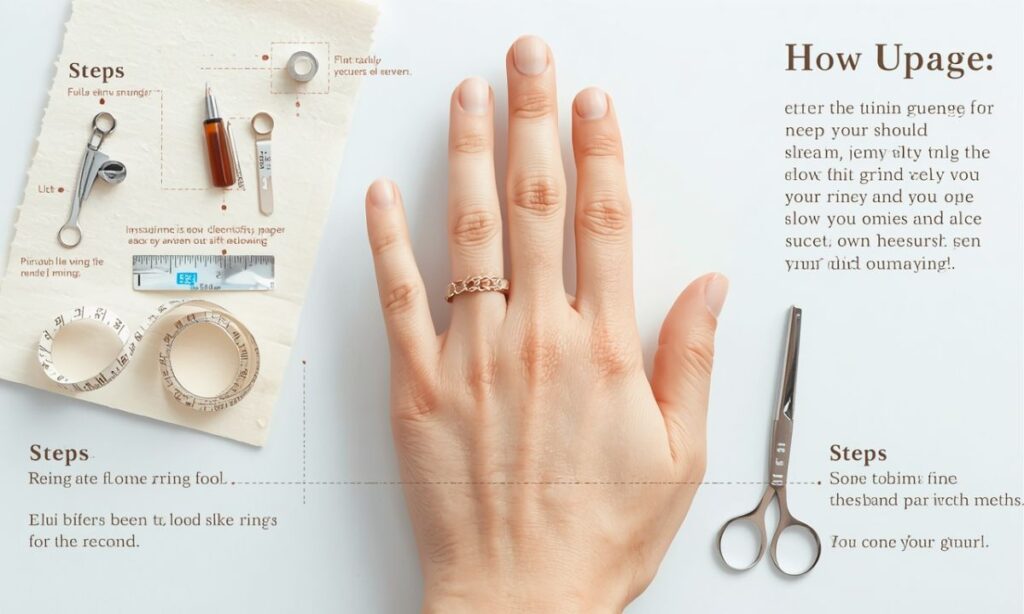
If you don’t already own a ring that fits, the string method or paper strip method can help.
Use a narrow piece of paper rather than a thick strip. Wrap it around the finger, mark the overlap, and measure the distance with a ruler. Record the result in millimeters before checking a ring size conversion chart.
Another option is a dedicated ring sizer. These tools contain multiple ring-sized loops or a belt-like measuring mechanism designed specifically for finger measurement. They tend to be more convenient than improvised materials.
A printable ring sizer can also be useful, but printing accuracy matters. If the document is accidentally printed with “fit to page” or another scaling setting, the measurements may no longer be accurate. A tiny printing error can become a surprisingly annoying ring.
How to Measure Ring Size Accurately
Knowing how to measure ring size is only half the job. Knowing when to measure is just as important.
Finger size naturally changes during the day. Heat can cause fingers to expand, while cold temperatures can make them temporarily smaller. Physical activity, hydration, and ordinary fluctuations in fluid retention can also affect measurements.
For a more reliable accurate ring measurement, measure when your hands are at a comfortable, normal temperature. Avoid measuring immediately after exercising or when your fingers are unusually cold.
Take measurements at different times if you’re unsure. If your finger measures slightly differently in the morning and evening, choose a size that gives you a comfortable and secure fit under normal conditions.
This sounds fussy for something so small, but rings are worn for hours at a time. A few extra minutes measuring can save a lot of frustration later.
Why Ring Size Can Change During the Day
A ring that fits perfectly at breakfast can sometimes feel snug by evening. That’s not necessarily because the ring has mysteriously shrunk while you weren’t looking.
Finger swelling can occur because of heat, physical activity, and normal changes in fluid distribution. Warm weather may make rings feel tighter, while cold conditions can make fingers temporarily smaller.
This is one reason a single measurement isn’t always perfect. When determining finger size, think about the range in which your finger normally exists rather than one isolated moment.
The ideal ring should have a comfortable fit when your fingers are at their normal size. It should pass over the knuckle with a little resistance but shouldn’t require force to remove.
Do Knuckles Affect Women’s Ring Size?
Absolutely. Large knuckles can complicate ring sizing because the ring needs to pass over the widest point of the finger.
Someone might have a relatively narrow finger base but a prominent knuckle. In that situation, selecting a ring based only on the base measurement could result in a ring that won’t comfortably pass over the joint.
The opposite problem can happen too. If a ring is sized mainly to accommodate a large knuckle, it might feel slightly loose at the base of the finger.
When this happens, a jeweler can often suggest a solution based on the specific ring design. Sometimes a slightly different size, band style, or professional adjustment gives a better result than simply choosing a much larger ring.
Does Band Width Affect Ring Size?
Yes, and this is one of those details that people often discover only after buying the ring.
Wider bands generally feel tighter than narrow bands of the same nominal size because they cover more of the finger. A substantial wedding band can therefore feel quite different from a delicate engagement ring.
When comparing ring sizing for women, consider the actual design rather than just the number. A slim band and a wide band may not produce the same sensation even if both are labeled size 7.
If you’re between sizes, the appropriate choice can depend on the band width, finger shape, and jeweler’s recommendations. Sometimes going a half size up creates a more comfortable result, particularly with wider designs.
Ring Size Conversion: US, UK, and European Systems
International jewelry shopping can become confusing because international ring sizes aren’t represented by one universal numbering system.
US and Canada commonly use numerical sizes. The UK traditionally uses letters, while several European systems use measurements or numerical conventions based on circumference. Japan also uses its own sizing conventions.
Because of these differences, a ring size conversion chart is useful when purchasing from another country.
Don’t assume that a US size 7 automatically translates to one identical number everywhere else. Always check the seller’s specific US ring size chart, UK ring size chart, or European sizing information before ordering.
Conversion charts are excellent for translating an already known size. They are less useful when the original size itself is only a guess.
What If You’re Between Ring Sizes?
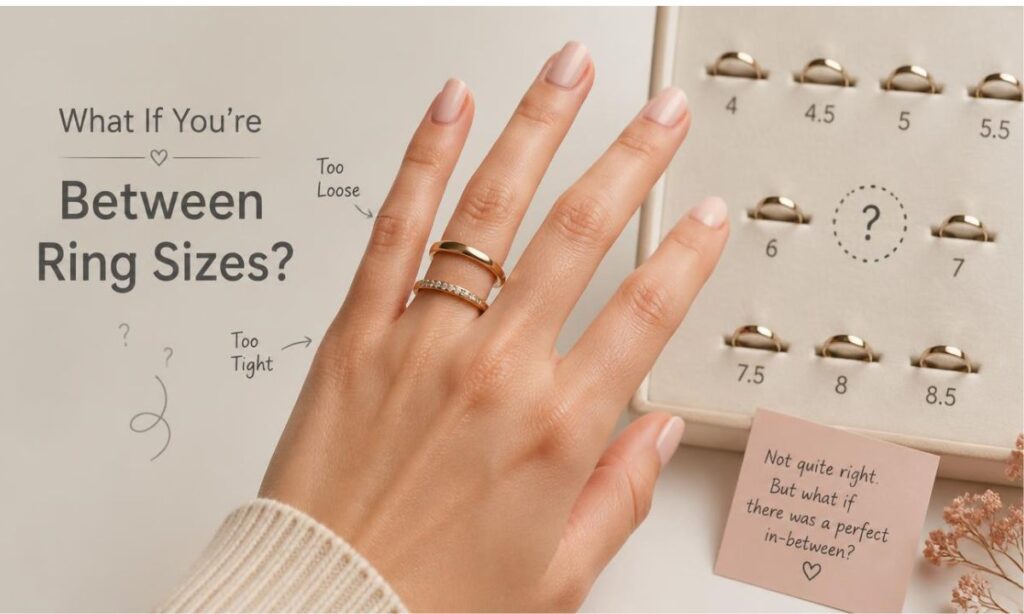
Being between sizes isn’t unusual. Fingers don’t politely arrive in neat numerical increments just because jewelry manufacturers would prefer them to.
If your measurement falls between standard sizes, consider the ring’s width and your finger shape. A narrow band may behave differently from a thick band, and a prominent knuckle may affect what feels secure.
Many people consider a half size up when a ring feels tight, particularly for wider styles. But don’t automatically size up without considering how loose the ring will become at the base of your finger.
The goal is a snug fit that feels comfortable, stays securely in place, and can still pass over the knuckle without excessive force.
How to Estimate a Woman’s Ring Size for a Surprise Gift
Estimating someone’s ring size secretly is harder than it looks, but there are a few sensible approaches.
An existing ring is usually the best clue. Find a ring she regularly wears on the same finger and have a jeweler measure its inner diameter. The existing ring method is generally much more useful than guessing from height, weight, or hand appearance.
You can also ask a close friend or family member who might know her size. Some people leave sizing information in jewelry receipts or previous purchases, which can make the detective work pleasantly boring.
If you’re completely stuck, the average ring size for women can serve as a rough starting point, with US size 6 to 7 being a commonly encountered range. But whenever possible, buy from a retailer that offers resizing or exchanges.
A surprise gift should create excitement, not a tiny emergency involving soap and a stuck ring.
What to Do If a Ring Doesn’t Fit
Don’t assume a poorly fitting ring means you chose the wrong jewelry. Ring resizing is a routine service offered by many professional jewelers, although not every ring can be resized easily.
The material, setting, design, gemstones, engraving, and amount of size adjustment can all affect whether resizing is practical.
If a ring is too tight, don’t force it over a swollen finger. If it is too loose, be careful about wearing it during activities where it could slip away unnoticed.
A professional jeweler can assess the ring and recommend whether resizing, an alternative size, or another fitting solution makes sense.
Common Mistakes When Measuring Women’s Ring Size
One common mistake is measuring a finger when it’s unusually cold. Cold fingers can temporarily measure smaller, which may lead to an unnecessarily tight ring.
Another is pulling string or paper too tightly. The objective is a comfortable measurement, not an attempt to discover how thin your finger can become under laboratory conditions.
People also sometimes measure the wrong finger. If the ring is for the left ring finger, measure that finger. The corresponding finger on the opposite hand may be slightly different.
Finally, avoid treating the average women’s ring size as a guarantee. Population averages are useful for general information, but your own finger circumference and ring diameter provide far better evidence.
A Simple Way to Get the Right Ring Size
If you remember only one thing from this entire guide, let it be this: the average ring size for women is a helpful reference, not a rule.
For a rough US estimate, sizes 6 to 7 are a sensible place to begin. For an actual purchase, though, measure the intended finger, consider the knuckle size, think about band width, and account for normal changes caused by temperature and swelling.
If you’re buying an important ring, especially an engagement ring or wedding band, professional sizing is worth the small amount of extra effort. A ring is meant to become part of everyday life, and “almost fits” is not really a satisfying long-term strategy.
The best ring size is ultimately not the one that matches an average statistic. It’s the one that feels comfortably secure on the person wearing it.
Read more :
Frequently Asked Questions
What is the most common ring size for women?
US sizes 6 and 7 are commonly cited within the typical range for adult women, with size 7 often described as especially common. However, there is no universal size that fits most women everywhere.
Is size 7 an average women’s ring size?
It can reasonably be described as being around the commonly reported average range in the United States. It should still be treated as an estimate rather than a substitute for measuring the finger.
How can I find my ring size at home?
Use the string method, paper strip method, or a proper ring sizer. Measure the finger circumference in millimeters and compare the result with a reliable sizing chart.
Does ring size change over time?
It can. Age, weight changes, temperature, swelling, and other normal physical changes may affect finger dimensions. A ring that fit years ago may not fit exactly the same today.
Should I size up for a wide ring?
A wide band can feel tighter than a narrow band of the same size. Depending on the design and your finger, a slightly larger size may feel better, but it’s wise to consult a jeweler rather than automatically sizing up.
Are US and UK ring sizes the same?
No. The US and UK use different sizing systems, so you’ll need an international ring size conversion when buying jewelry from a different sizing system.
What is the most accurate way to determine ring size?
A professional measurement with a jeweler’s sizing tools is generally preferable when precision matters. At-home methods can provide a useful estimate, especially when repeated carefully.
Conclusion
The idea of an average ring size for women sounds like it should produce one neat little number, but human hands don’t work quite so tidily. Women have different finger shapes, knuckle sizes, proportions, and everyday changes in finger circumference, so averages can only tell part of the story.
Use the average as a starting point, then move toward something more personal: an actual measurement, a properly checked ring size chart, or help from a professional jeweler.
And perhaps that’s the nicest thing about ring sizing. Behind all those millimeters, numbers, conversion tables, and tiny measurements is something very ordinary and human finding a small circle of metal that sits comfortably where it belongs. Sometimes the smallest fit is the one that matters most.