

Have you ever looked at the clock in the morning and wondered where you’ll be ten hours later? Perhaps you’re planning a long work shift, waiting for an important phone call, or simply trying to figure out when you’ll finally get a little time to yourself. Time has a funny way of slipping through our fingers, and sometimes a small calculation can make the whole day feel easier to manage.
The question “10 hours from now is what time?” has a straightforward answer: add ten hours to your current time. However, the exact result depends on when you’re starting and whether those hours carry you past midnight into the next calendar day. A little clock math can save you from missed appointments and confusing schedules.
For example, if the current time is 8:19 AM, adding ten hours gives you 6:19 PM on the same day. If it’s already 7:30 PM, the answer becomes 5:30 AM tomorrow. Same ten hours, different part of the day. That’s the small detail that makes future time calculation worth understanding.
In this guide, we’ll explore how to calculate ten hours ahead, use an hours-from-now calculator, convert hours into smaller units, and handle time zones without making the process more complicated than it needs to be.
How to Calculate the Time 10 Hours From Now
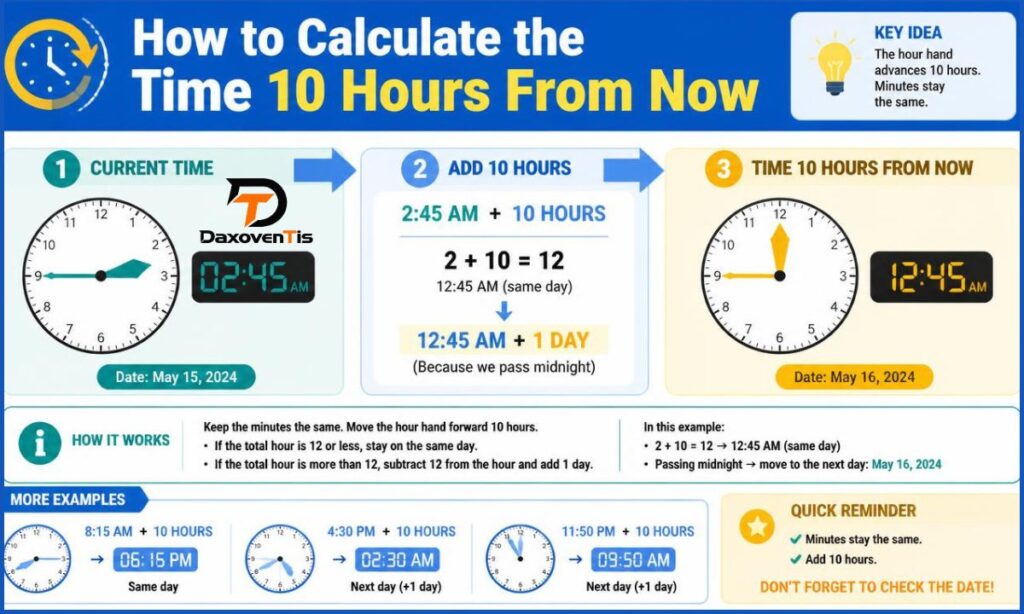
The answer depends on your current local time. To find the future time, simply add ten hours to the hour shown on your clock while keeping track of AM, PM, and any change of date.
Here are some quick examples to make the calculation easier to understand.
| Current time | 10 hours from now |
|---|---|
| 6:00 AM | 4:00 PM today |
| 8:19 AM | 6:19 PM today |
| 10:00 AM | 8:00 PM today |
| 12:00 PM (noon) | 10:00 PM today |
| 2:00 PM | 12:00 AM tomorrow |
| 7:30 PM | 5:30 AM tomorrow |
| 9:00 PM | 7:00 AM tomorrow |
| 11:00 PM | 9:00 AM tomorrow |
These examples show how a ten-hour interval can end in the afternoon, evening, or early morning. The starting time determines the result, so always check your clock before making plans.
If you need an exact answer down to the minute, use the current hours and minutes displayed on your device. For instance, 8:19 AM becomes 6:19 PM after adding ten hours because the minutes remain unchanged.
What Time Will It Be in 10 Hours? A Simple Calculation
You don’t need advanced mathematics to calculate a future clock time. Basic addition is enough, although the 12-hour clock can occasionally make the process look a little tricky.
Let’s use 8:19 AM as an example.
- Start with the current time: 8:19 AM.
- Add ten hours to the hour: 8 + 10 = 18.
- Convert 18:19 into the 12-hour clock format: 6:19 PM.
- Check the date: because the result is before midnight, the date stays the same.
Therefore, 10 hours from 8:19 AM is 6:19 PM on the same day.
Now imagine it’s 7:30 PM instead. Adding ten hours gives 29:30 when the starting time is expressed as a continuous count from midnight. Subtracting 24 hours gives 5:30 AM the following day.
This is called a date rollover. It happens whenever your calculation crosses midnight, and it’s an important part of accurate time arithmetic.
How to Use a 10 Hours From Now Calculator
An online 10 hours from now calculator makes the process even simpler. Rather than working through the addition yourself, you enter a starting time, choose the required interval, and let the tool calculate the result.
Most time calculators follow a similar process:
- Enter the starting time: Use your current local time or another time you want to calculate from.
- Choose the duration: Enter 10 hours.
- Calculate the future time: The tool adds the interval to your starting point.
- Check the date: Confirm whether the result falls today or tomorrow.
- Review the time format: Make sure the result is displayed in AM/PM or 24-hour format according to your preference.
A good Hours From Now Calculator can be helpful when you’re organizing meetings, planning travel, or setting reminders. Some tools also support minutes and seconds, which is useful when a schedule needs greater precision.
Remember that the calculator needs the correct starting time and, when relevant, the correct time zone. An incorrect input can produce a perfectly calculated but entirely unhelpful answer.
Understanding the Difference Between 12-Hour and 24-Hour Time
The 12-hour clock divides the day into two periods: AM and PM. The 24-hour clock counts continuously from 00:00 at midnight to 23:59 just before the next midnight.
Both formats can calculate ten hours ahead accurately. They simply represent the same moment differently.
| 12-hour clock | 24-hour clock |
|---|---|
| 8:19 AM | 08:19 |
| 12:00 PM | 12:00 |
| 2:00 PM | 14:00 |
| 6:19 PM | 18:19 |
| 7:30 PM | 19:30 |
| 12:00 AM | 00:00 |
For example, if the current time is 14:00, adding ten hours produces 24:00 mathematically. In standard clock notation, that becomes 00:00 on the next calendar day.
This is why the 24-hour format can be especially useful for hospitals, transport schedules, computer systems, and international travel. It removes much of the uncertainty surrounding AM and PM.
How Many Minutes, Seconds, and Milliseconds Are in 10 Hours?
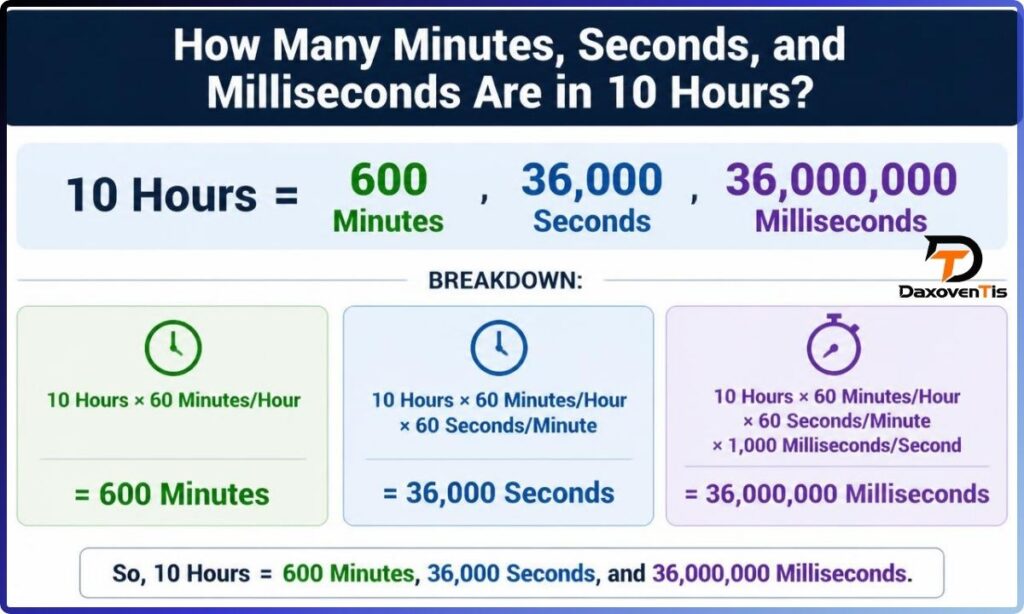
Sometimes you need more than the future clock time. Perhaps you’re calculating a work duration, checking a software timestamp, or measuring the length of a scheduled activity.
Ten hours can be expressed in several smaller units.
| Time unit | Equivalent |
|---|---|
| Hours | 10 |
| Minutes | 600 |
| Seconds | 36,000 |
| Milliseconds | 36,000,000 |
The conversions are simple:
- Hours to minutes: \(10 \times 60 = 600\) minutes.
- Hours to seconds: \(10 \times 60 \times 60 = 36{,}000\) seconds.
- Hours to milliseconds: \(36{,}000 \times 1{,}000 = 36{,}000{,}000\) milliseconds.
These values describe a ten-hour duration under ordinary time arithmetic. If you’re working with real timestamps across daylight-saving changes, the actual elapsed time and displayed local clock time may need separate consideration.
Does Adding 10 Hours Change the Date?
It can, and this is one of the most common sources of confusion when people calculate a future time.
If you start at 8:00 AM, ten hours later is 6:00 PM on the same day. But if you start at 4:00 PM, ten hours later is 2:00 AM tomorrow.
The date changes whenever the calculation passes midnight.
Consider these examples:
- 10:00 AM + 10 hours = 8:00 PM today.
- 2:00 PM + 10 hours = 12:00 AM tomorrow.
- 8:00 PM + 10 hours = 6:00 AM tomorrow.
- 11:30 PM + 10 hours = 9:30 AM tomorrow.
If you’re calculating a time close to midnight, remember to update the calendar date as well as the clock. This matters for hotel check-ins, flight arrivals, work shifts, online appointments, and reminders that must occur on the correct day.
Practical Reasons to Calculate 10 Hours From Now
A future time calculation may seem like a tiny task, but it can help you organize several parts of everyday life. Once you know the exact time, you can plan around it instead of repeatedly checking the clock.
Work Shifts and Daily Scheduling
Imagine you start work at 8:00 AM and have a ten-hour period scheduled. The end of that period is 6:00 PM, assuming the interval starts at 8:00 AM and runs continuously.
For a ten-hour shift, however, remember that scheduled breaks may affect your actual working hours. Ten hours between clock-in and clock-out doesn’t necessarily mean ten hours of active work.
Travel and Flight Planning
A ten-hour flight departing at 7:30 PM would reach the end of its ten-hour duration at 5:30 AM the next day if calculated using the same time reference.
Actual arrival times can differ because of time zones, daylight-saving changes, and the local times used by airlines. Always check the itinerary for the airport’s local departure and arrival times.
Meetings and International Communication
Remote work often involves coordinating with colleagues in different countries. Calculating ten hours ahead can help you determine when a message, meeting, or reminder will fall.
For example, if you’re in Pakistan using GMT+5, your local calculation starts from Pakistan’s current clock time. A colleague in Europe or North America may see a different local clock time at the same moment.
For international meetings, calculate the duration first and then convert the resulting instant to the other person’s time zone.
Sleep and Personal Routines
If you go to bed at 9:00 PM and want to know what the clock will show ten hours later, the answer is 7:00 AM tomorrow.
That can help you plan a morning routine, set an alarm, or organize your day. Just remember that ten hours in bed isn’t necessarily ten hours of sleep, since falling asleep and waking during the night affect actual sleep duration.
Reminders and Online Activities
Ten-hour calculations can also help with online gaming sessions, email scheduling, calendar events, activity tracking, and software monitoring.
A system log recorded ten hours earlier can be compared with a future timestamp to investigate events or check elapsed time. In these cases, using a consistent time zone and accurate timestamps helps prevent mistakes.
How to Calculate 10 Hours From Now Across Midnight
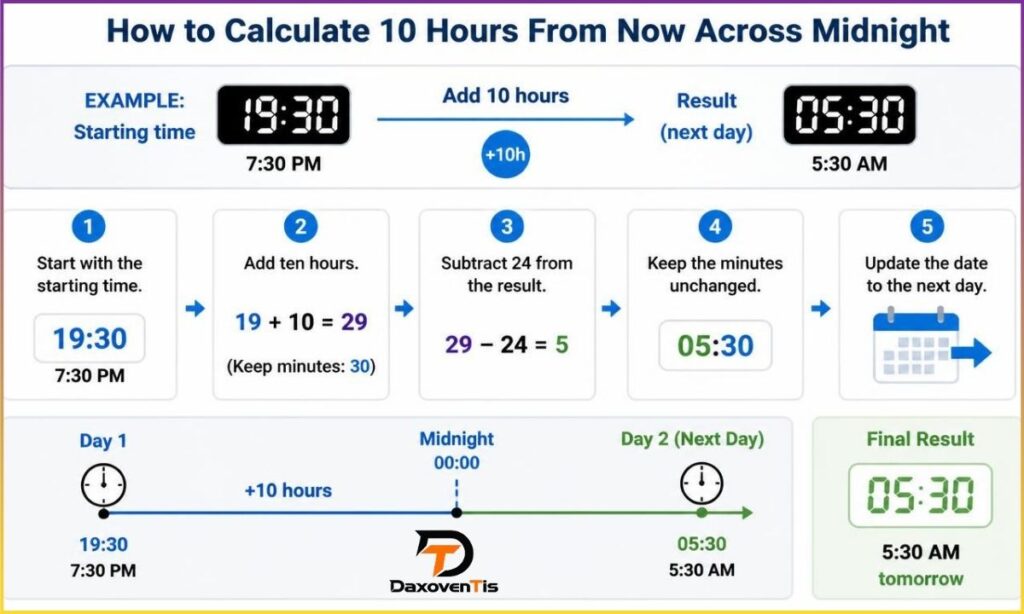
Crossing midnight sounds more complicated than it really is. The easiest method is to use the 24-hour clock, add ten, and subtract 24 if the result reaches or exceeds 24.
For example, suppose the starting time is 19:30, or 7:30 PM.
- Add ten hours: \(19 + 10 = 29\).
- Subtract 24 from the result: \(29 – 24 = 5\).
- Keep the minutes unchanged: 30.
- Update the date to the next day.
The result is 05:30, or 5:30 AM tomorrow.
If the starting time is 14:00, adding ten hours gives 24:00. That corresponds to 00:00 on the next day, which is midnight.
This method works well for manual time calculation and is especially useful when working with transport schedules or a digital clock that displays the 24-hour format.
How Time Zones Affect a Future Time Calculation
The phrase “ten hours from now” usually refers to ten hours after the present moment, not ten hours after a particular local clock reading in another country.
Suppose you’re in Pakistan and it’s 8:19 AM in your local time zone, GMT+5. Ten hours later is 6:19 PM in Pakistan.
A person in another country will generally see a different clock reading at that same future instant because their time zone may have a different UTC offset.
To calculate correctly:
- Start with the current local time and date.
- Add ten hours to determine the future instant.
- Convert that instant into the destination’s time zone if you’re planning an international event.
- Check whether daylight-saving time applies in the destination location.
A Time Zone Calculator is particularly helpful for remote teams, international calls, and cross-border meetings. Avoid assuming that every country uses the same UTC offset throughout the year.
What Time Was It 10 Hours Ago?
A related question is the reverse of calculating ten hours ahead. Instead of adding ten hours, subtract ten hours from the current time.
For example, if the current time is 8:19 AM, subtracting ten hours gives 10:19 PM on the previous day.
Here are a few examples:
| Current time | 10 hours ago |
|---|---|
| 8:19 AM | 10:19 PM yesterday |
| 12:00 PM | 2:00 AM today |
| 2:00 PM | 4:00 AM today |
| 7:30 PM | 9:30 AM today |
| 11:00 PM | 1:00 PM today |
Notice that subtraction can move the result into the previous calendar day, just as addition can move it into the next one.
A previous-time calculation is useful for reviewing historical timestamps, checking work records, understanding activity logs, or figuring out when an earlier event occurred.
Common Mistakes to Avoid When Adding 10 Hours
Even though the calculation is straightforward, a few small mistakes can lead to the wrong answer.
- Forgetting AM and PM: Adding ten hours to 8:00 AM gives 6:00 PM, not 6:00 AM.
- Ignoring midnight: If the result passes midnight, the calendar date must advance.
- Confusing noon and midnight: 12:00 PM is noon, while 12:00 AM is midnight.
- Mixing time zones: A future time in Pakistan may not match the clock time in another country.
- Ignoring minutes: If the starting time is 8:19, the result is normally 6:19, not 6:00.
- Assuming a shift equals active working time: Scheduled breaks may mean the actual work duration is shorter than the full interval.
Taking a moment to verify the starting time, date, and time zone can prevent most of these errors.
Read more : 4 Weeks From Now
Frequently Asked Questions
10 hours from now is what time?
The answer depends on the current time. If it’s 8:19 AM, ten hours later is 6:19 PM on the same day. If it’s 7:30 PM, ten hours later is 5:30 AM tomorrow.
What time will it be exactly 10 hours from now?
Add ten hours to your current local clock time. Keep the minutes unchanged unless your starting calculation includes additional minutes, and move the date forward if the result crosses midnight.
How do you calculate 10 hours from the current time manually?
Add ten to the hour using the 24-hour clock. If the result is 24 or greater, subtract 24 and advance the calendar date by one day.
How many minutes are in 10 hours?
Ten hours equals 600 minutes, calculated by multiplying 10 by 60.
How many seconds are in 10 hours?
Ten hours equals 36,000 seconds, because each hour contains 3,600 seconds.
How many milliseconds are in 10 hours?
Ten hours equals 36,000,000 milliseconds, using 1,000 milliseconds per second.
Does 10 hours from now fall on the next day?
Sometimes. If the starting time is later than approximately 2:00 PM, adding ten hours will generally reach midnight or pass into the next calendar day. At exactly 2:00 PM, the result is midnight at the start of the following day.
How do you add 10 hours to PM time?
Convert the starting time to the 24-hour format, add ten hours, and adjust the date if the result reaches midnight. For example, 7:30 PM becomes 19:30; adding ten hours produces 05:30 the next day.
How does a future time calculator work?
A future time calculator adds a chosen duration to a starting time and adjusts the date when necessary. More advanced tools may also account for time zones, calendar dates, and daylight-saving rules.
Can I calculate 10 hours from now manually?
Yes. You only need the current time and basic addition. The 24-hour clock is often the easiest approach because it makes midnight transitions more straightforward.
How do time zones affect future time calculations?
The same future instant can appear as different clock times in different locations. Calculate the future instant first, then convert it to the destination’s local time zone when coordinating international schedules.
Conclusion
Figuring out 10 hours from now doesn’t need to become a guessing game. Whether you’re planning a work shift, preparing for a trip, setting a reminder, or simply curious about what the clock will show later, the basic rule stays the same: add ten hours to the starting time and check whether the date changes.
Remember the useful conversions, too. Ten hours equals 600 minutes, 36,000 seconds, and 36,000,000 milliseconds. These numbers can help with everything from everyday planning to technical calculations.
Most importantly, use the correct starting time and time zone whenever accuracy matters. A quick manual calculation or an online time calculator can make your schedule easier to manage, leaving you with one less little thing to worry about as the day moves along.