

There is something surprisingly special about holding a Pokémon card between your fingers. A little piece of printed cardstock can carry years of childhood memories, the excitement of opening a booster pack, or the thrill of finding a shiny Charizard that you thought you had lost forever. And yet, one small detail matters more than many collectors realise: the Pokémon card size.
Whether you’re building a collection, buying protective sleeves, organizing a binder, or checking a vintage card, knowing the correct measurements makes everything a bit easier. A sleeve that is too tight can damage corners, while a pocket that’s too large may let a valuable card slide around. It’s a small thing, sure, but collectors know that small things matter.
The standard Pokémon Trading Card Game (Pokémon TCG) card measures 2.5 × 3.5 inches (63.5 × 88.9 mm). Most regular Pokémon cards follow this familiar format, including Basic Pokémon, Evolution Pokémon, Trainer cards, and Energy cards. Oversized promotional cards are a different story, so it’s worth understanding both formats before buying accessories.
What Is the Standard Pokémon Card Size?
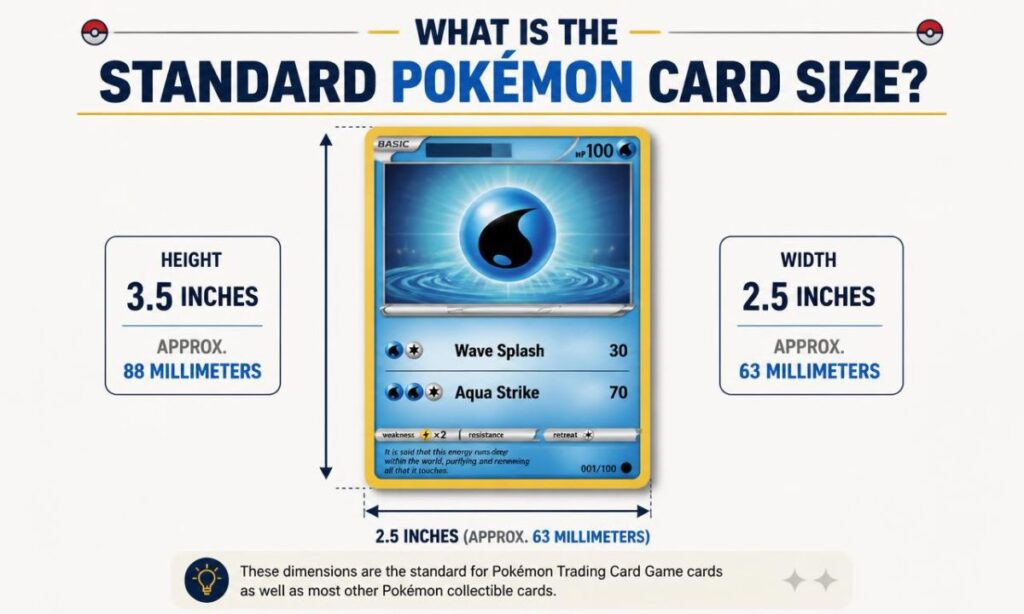
The standard Pokémon card size is 2.5 inches wide and 3.5 inches tall. In metric measurements, that equals 63.5 mm wide by 88.9 mm tall. These dimensions make the cards comfortable to hold, shuffle, organize, and protect.
If you’ve ever held a Pikachu card in one hand and a Charizard card in the other, you’ve probably noticed that the artwork and text can change dramatically, but the physical dimensions generally stay the same. That’s the beauty of standardized card production: players can use different cards together without worrying about mismatched sizes.
Here are the commonly referenced physical specifications for a regular Pokémon card:
| Measurement | Approximate value |
|---|---|
| Width | 2.5 inches / 63.5 mm |
| Height | 3.5 inches / 88.9 mm |
| Aspect ratio | 5:7 |
| Thickness | About 0.012 inches / 0.305 mm |
| Weight | About 1.78 grams |
| Corner radius | Approximately 3.18 mm |
These thickness, weight, and corner-radius figures are useful reference estimates, not guaranteed specifications for every card. Printing batches, finishes, condition, and measuring equipment can create small differences. The width and height are the main measurements to use when shopping for sleeves and binders.
Pokémon Card Size in Inches and Millimeters
When you’re searching for sleeves online, you’ll often see measurements listed in inches, millimeters, or both. Understanding these units helps you choose accessories that fit properly, especially if you’re buying from an international seller.
The Pokémon card size in inches is 2.5 × 3.5 inches, while the Pokémon card size in mm is 63.5 × 88.9 mm. Both measurements describe the same standard rectangular card, just using different units.
| Measurement | Inches | Millimeters |
|---|---|---|
| Card width | 2.5 in | 63.5 mm |
| Card height | 3.5 in | 88.9 mm |
| Approximate thickness | 0.012 in | 0.305 mm |
| Approximate corner radius | 0.125 in | 3.18 mm |
A quick tip: when shopping for a card sleeve, look for compatibility with standard-size trading cards or Pokémon TCG cards rather than relying only on the product’s outside dimensions. The sleeve’s internal dimensions are what matter most for a comfortable fit.
How Thick Is a Pokémon Card?
A standard Pokémon card is often described as approximately 0.305 mm thick, or 0.012 inches. That’s thin enough to shuffle easily but sturdy enough for normal handling when the card is in good condition.
The card isn’t simply a single sheet of ordinary paper. Its construction uses printed cardstock and layered paper-based materials, with a surface finish designed to support the artwork, readable text, and familiar feel of the card. Exact material composition can vary by production and card type.
Why Card Thickness Matters
Thickness can affect several everyday collecting activities:
- Shuffling: Consistent card thickness helps a deck feel uniform in your hands.
- Sleeve fitting: A card should slide into a sleeve without excessive force or unwanted movement.
- Storage: Stacked cards take up space, and protective sleeves increase the overall thickness.
- Authenticity checks: An unusual thickness may be a reason to inspect a card more carefully, though it isn’t proof that the card is fake.
If you’re measuring a card at home, use a precise digital caliper gently and avoid squeezing the card. Even a small amount of pressure can affect the reading, and pressing too hard risks damaging the cardstock.
How Much Does a Pokémon Card Weigh?
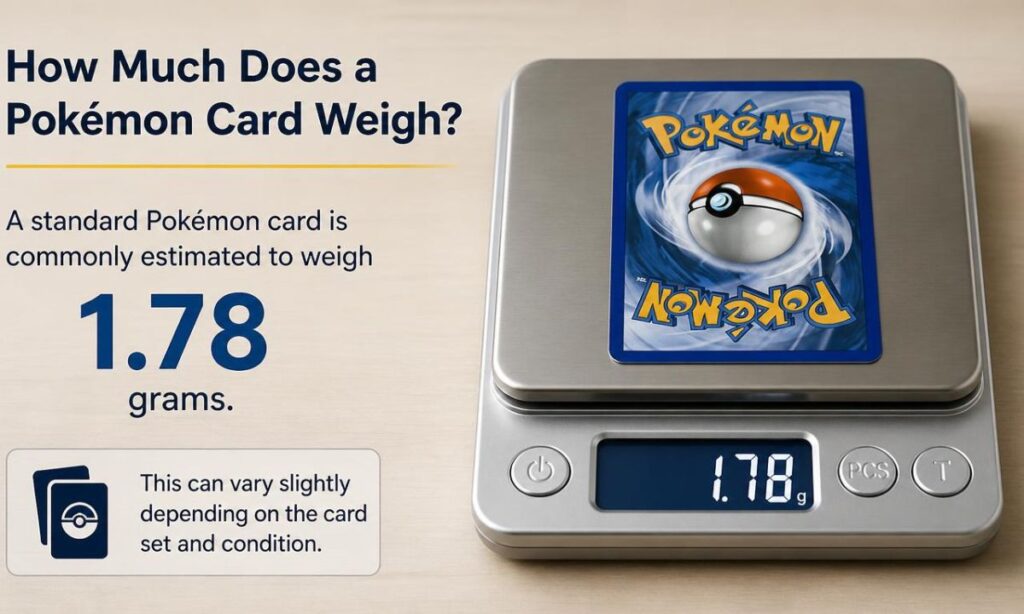
A standard Pokémon card is commonly estimated to weigh around 1.78 grams. That’s a useful ballpark figure for understanding the physical characteristics of a card, but it shouldn’t be treated as an official, universal weight for every Pokémon card.
A holographic card, a card with a different finish, or a card from another production run may have slightly different characteristics. Moisture, dirt, wear, and measurement precision can also affect the result.
For collectors, weight is most useful as one piece of a broader inspection. If a suspicious card weighs noticeably more or less than a comparable authentic card, it deserves a closer look. But a digital scale alone cannot confirm authenticity, so don’t make a buying decision based on weight alone.
Do All Pokémon Cards Have the Same Dimensions?
Most regular Pokémon TCG cards share the same standard dimensions, regardless of their role in the game. A Basic Pokémon, an Evolution Pokémon, a Trainer card, and an Energy card will generally fit the same standard-size sleeves.
That consistency makes collecting less complicated. You can organize different sets together, build a deck using cards from different expansions, and protect a collection without purchasing a separate sleeve size for every card category.
There are, however, some exceptions worth knowing about.
- Standard Pokémon cards: Most regular playable cards measure 2.5 × 3.5 inches.
- Promotional Pokémon cards: Many promotional cards use the standard format, although special releases can differ.
- Oversized Pokémon cards: These are made for display, collection, or special promotional purposes rather than ordinary deck play.
- Special products: A product may include jumbo cards or other unusual formats alongside regular cards.
The card’s artwork, rarity, or holographic effect doesn’t automatically change its dimensions. A rare card is not necessarily a larger card.
Pokémon Card Size Throughout the Base Set Era
The Pokémon Trading Card Game grew into a worldwide collecting phenomenon after its early releases. The original Japanese Pokémon TCG launched in 1996, while the English-language Base Set followed in 1999. Vintage cards from the early sets helped establish the familiar dimensions that collectors still recognize today.
Cards featuring Charizard, Blastoise, Venusaur, and Pikachu became memorable parts of the hobby. Many collectors still enjoy the tactile feeling of vintage cards, even when their surfaces show a little wear from years of play.
Pokémon Base Set Card Dimensions
Regular cards from the original English Base Set generally follow the standard 2.5 × 3.5-inch format. The same basic dimensions apply to many other vintage Pokémon cards, although their printing, finish, and condition can differ from modern releases.
A vintage holographic Charizard can feel different from a newer card because of its finish, age, or physical condition. However, its collectible value comes from factors such as rarity, demand, edition, and condition, not simply from being a particular size.
If you’re examining a vintage collection, measure the card without bending it, compare it with a trusted reference card, and inspect the printing and surface details. This is especially useful when buying valuable cards from unfamiliar sellers.
What Size Sleeves Fit Pokémon Cards?
Choosing the right sleeves is one of the easiest ways to protect a collection. Standard Pokémon cards fit sleeves designed for cards measuring approximately 2.5 × 3.5 inches, but the sleeve itself needs a little extra room so the card can slide in safely.
When looking at standard Pokémon card sleeves size, pay attention to the manufacturer’s stated card compatibility and internal measurements. Sleeve dimensions printed on packaging can refer to the sleeve’s outside size rather than the usable space inside.
Penny sleeves
An inexpensive, lightweight choice for everyday storage and protecting cards from fingerprints, dust, and minor surface contact. They’re useful when sorting large collections or storing duplicates.
Premium card sleeves
These provide a more substantial feel and are popular for cards used in regular gameplay. Choose sleeves designed specifically for standard-size trading cards.
Toploaders
Rigid plastic protectors add support and help prevent bending. They are especially useful for valuable cards, prized pulls, and cards being transported or sold.
Binder pocket pages
These help keep a collection organized by set, Pokémon type, rarity, or personal preference. Check that the pockets fit sleeved cards if you intend to store them with sleeves.
Should You Double Sleeve Pokémon Cards?
Double sleeving means placing a card inside two compatible sleeves for additional protection. Collectors often use this method for valuable cards or cards they handle frequently.
Make sure both sleeves are compatible and that the combined thickness fits your storage system. Avoid forcing a card into a tight inner sleeve, because pressure on the corners can cause whitening, bends, or other damage.
For ordinary cards, a single good-quality sleeve may be perfectly adequate. You don’t need to turn every common card into a heavily protected treasure chest.
What Size Toploader Is Best for Pokémon Cards?
A standard toploader designed for regular trading cards is generally the right starting point for Pokémon cards. Many common toploaders are marketed for cards measuring 2.5 × 3.5 inches, but the correct choice depends on the internal opening and whether the card is sleeved.
A toploader should hold the card securely without forcing it into the plastic. If you’re using a penny sleeve first, check that the sleeved card fits comfortably and that its corners won’t catch on the opening.
For valuable cards, consider these simple precautions:
- Place the card into a compatible sleeve before inserting it into the toploader.
- Keep your hands clean and dry when handling the card.
- Avoid pushing a card into a protector that feels too tight.
- Store protected cards upright or in a stable container where they won’t slide around excessively.
- Keep the collection away from direct sunlight, excessive heat, and damp environments.
For a rare holographic Charizard, a little care goes a long way. Scratches, bent corners, and surface wear can influence a card’s condition grade and potentially its resale value.
What Size Are Oversized Pokémon Cards?
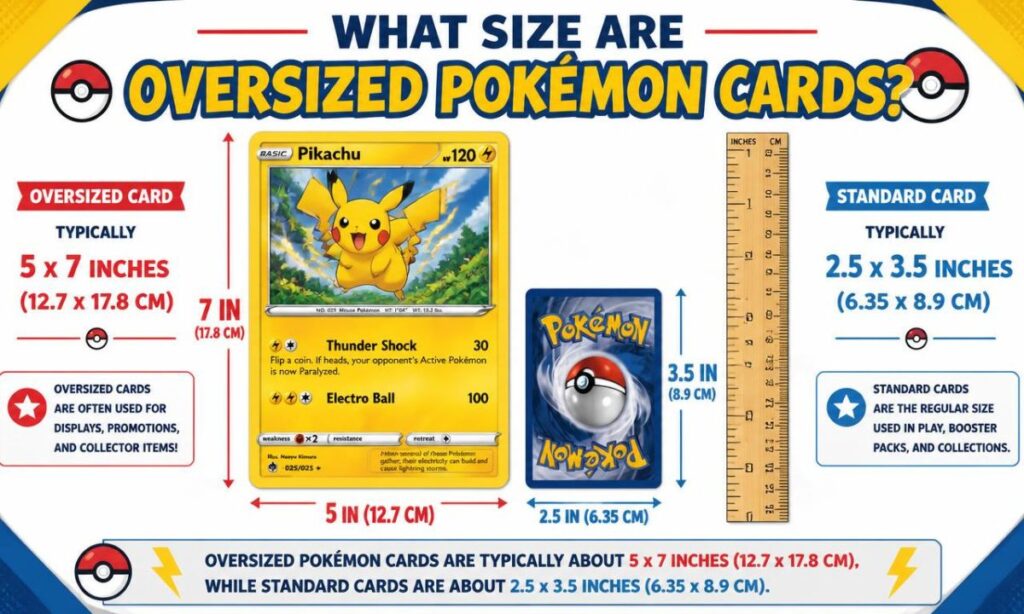
Not every Pokémon card is made for a regular deck. Some special products contain oversized Pokémon cards, which are larger display pieces intended for collectors rather than normal gameplay.
A frequently encountered jumbo-card format is around 5 × 7 inches, although oversized Pokémon cards are not all identical. Their exact dimensions can vary by release, so measure the particular card before purchasing a frame, sleeve, or display holder.
Oversized cards may feature popular Pokémon, promotional artwork, or designs associated with special products. They’re fun to display because the artwork becomes more prominent, but they require different storage accessories from regular cards.
If you have an Elite Trainer Box (ETB), booster bundle, or other special product, check its contents before assuming every included card will fit a standard binder. Most regular cards will, but special inserts and promotional formats may need separate storage.
Pokémon Card Size Compared With Other Trading Card Games
Pokémon cards aren’t the only collectible cards that use a standardized rectangular format. Other trading card games have their own dimensions, and knowing the differences can save you from buying the wrong accessories.
| Trading card game | Common card dimensions | Sleeve compatibility |
|---|---|---|
| Pokémon TCG | 2.5 × 3.5 in | Standard-size sleeves |
| Magic: The Gathering | 2.5 × 3.5 in | Generally compatible with standard-size sleeves |
| Yu-Gi-Oh! | Approximately 2.3 × 3.3 in | Usually requires Japanese-size sleeves |
| KeyForge | Standard-size format commonly around 2.5 × 3.5 in | Check the product’s specifications |
These measurements are general reference figures; always verify the exact product and regional edition when precision matters.
Are Pokémon Cards the Same Size as Magic Cards?
Yes, standard Pokémon cards and standard Magic: The Gathering cards use the same nominal dimensions: 2.5 × 3.5 inches. This means many standard-size sleeves can work for both games.
However, sleeve brands differ in fit, thickness, texture, and quality. A sleeve that feels ideal for one deck may feel looser or tighter with another product, so checking the manufacturer’s recommendations is still worthwhile.
Are Pokémon Cards the Same Size as Yu-Gi-Oh! Cards?
No, not usually. Standard Yu-Gi-Oh! cards are narrower and slightly shorter than standard Pokémon cards. They’re commonly associated with Japanese-size sleeves, while Pokémon cards generally use standard-size sleeves.
Don’t buy sleeves just because a listing says “trading card sleeves.” Check whether the seller specifies standard or Japanese size. It saves money, time, and the slightly annoying experience of discovering that your new sleeves don’t fit.
Can Pokémon Card Size Help Identify Fake Cards?
Card dimensions can help with a Pokémon card authenticity check, but size alone cannot tell you whether a card is genuine. Counterfeit cards may have incorrect proportions, uneven corners, unusual thickness, or poor printing, while some fakes can closely imitate the dimensions of authentic cards.
If you’re wondering how to identify fake Pokémon cards, compare several characteristics instead of relying on one measurement.
- Dimensions: Measure the width and height and compare them with a trusted standard-size card.
- Cardstock quality: Notice whether the card feels unusually flimsy, thick, stiff, or paper-like.
- Printing alignment: Look for inconsistent borders, blurry text, distorted symbols, or poorly aligned artwork.
- Surface texture: Compare the finish and texture with a known authentic card of a similar type.
- Holographic pattern: Examine the foil effect and its placement, especially on cards that normally feature distinctive holographic finishes.
- Weight: Use a precise scale only as a supporting check, not as a final verdict.
A single difference doesn’t automatically prove a card is counterfeit. Genuine cards can vary slightly, and wear or damage can change their appearance. If the card is valuable, consult an experienced collector or reputable grading service rather than making an expensive decision based on a quick home test.
How Pokémon Card Size Affects Collecting and Value
The dimensions of a Pokémon card may seem like a technical detail, but they matter when preserving a collection. A card that fits properly in its sleeve and binder is less likely to suffer unnecessary corner damage from repeated handling.
For collectors, card condition can influence monetary value. A rare holographic Charizard in excellent condition may attract a very different price from the same card with creases, scratches, or worn edges. The exact value also depends on the edition, rarity, demand, and market conditions.
Still, not every card needs expensive protection. A sensible approach is to use basic sleeves for ordinary cards and stronger protection for cards that are particularly valuable or personally meaningful.
Sometimes, the card you care about most isn’t the one worth the most money. It might be a Pikachu you pulled as a child or a card a friend gave you years ago. That emotional value deserves a bit of protection too.
How to Measure a Pokémon Card at Home
You don’t need specialist equipment to check the standard Pokémon card size. A ruler with inch and millimeter markings is enough to measure the width and height of most cards.
Follow these simple steps:
- Place the card on a clean, flat surface.
- Measure its width from one straight edge to the opposite edge.
- Measure its height from the bottom edge to the top edge.
- Compare your readings with the standard dimensions of 63.5 × 88.9 mm.
- If thickness matters, use a digital caliper carefully without squeezing or bending the card.
For a valuable vintage card, avoid unnecessary handling during measurements. If you’re unsure about its authenticity or condition, a professional inspection may be more useful than repeated measuring.
Read more : What Time Was It 23 Hours Ago?
Frequently Asked Questions
What is the standard Pokémon card size?
The standard Pokémon card size is 2.5 × 3.5 inches, or 63.5 × 88.9 mm. Most regular Pokémon TCG cards use these dimensions.
What size sleeves fit Pokémon cards?
Standard-size trading card sleeves designed for 2.5 × 3.5-inch cards generally fit Pokémon cards. Check the sleeve’s internal dimensions and the manufacturer’s compatibility guidance before buying.
How thick is a standard Pokémon card?
A commonly referenced estimate is around 0.305 mm, or 0.012 inches. Actual thickness can vary slightly with manufacturing, finish, condition, and measurement technique.
How much does a Pokémon card weigh?
A standard card is often estimated at approximately 1.78 grams. This is a general reference value rather than a guaranteed specification for every card.
Are all Pokémon cards the same size?
Most regular Pokémon cards share the same dimensions, including Pokémon, Trainer, and Energy cards. Oversized promotional cards and jumbo display cards are notable exceptions.
What is the size of an oversized Pokémon card?
Some oversized Pokémon cards measure approximately 5 × 7 inches, but dimensions vary by release. Measure the card before purchasing a protective sleeve or display frame.
Are Pokémon cards the same size as Magic cards?
Yes. Standard Pokémon and Magic: The Gathering cards both generally measure 2.5 × 3.5 inches. Many standard-size sleeves are compatible with both games.
Can card dimensions prove that a Pokémon card is real?
No. Incorrect dimensions can raise suspicion, but genuine cards may have small manufacturing variations, and counterfeits may copy standard measurements. Printing, texture, cardstock, and other details should also be examined.
Conclusion
Understanding the Pokémon card size is a simple but valuable part of collecting. The standard 2.5 × 3.5-inch format makes most cards easy to sleeve, organize, trade, and enjoy, whether you’re building your first collection or protecting a prized vintage Base Set card.
Remember to check sleeve compatibility, choose storage that suits your collection, and handle valuable cards gently. You don’t need the most expensive accessories to be a thoughtful collector; a little knowledge and consistent care can make a real difference.
And perhaps that’s what makes collecting Pokémon cards so enjoyable. Every card has its own artwork, story, and place in someone’s collection. Keep yours protected, enjoy the memories attached to them, and don’t forget to share your favourite Pokémon card or collecting tip with other fans.